


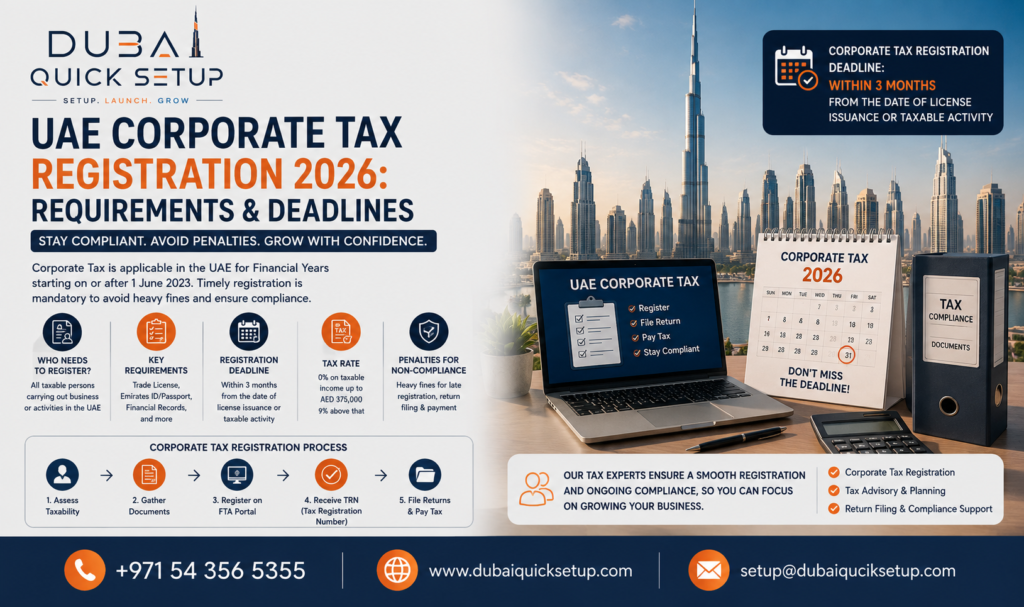
UAE Corporate Tax Registration is an important compliance requirement for businesses operating in the United Arab Emirates. Since the introduction of the UAE Corporate Tax regime, companies, free zone businesses, and certain individuals conducting business activities have needed to understand whether they are required to register with the Federal Tax Authority (FTA), when registration is due, what documents are required, and how Corporate Tax filing works after registration.
For businesses planning their tax compliance in 2026, one of the most common questions is: Who needs to register for UAE Corporate Tax, what documents are required, and when is the registration deadline?
The answer depends on the legal structure, residency status, business activity and, in some cases, turnover or UAE nexus.
The UAE Corporate Tax regime generally applies to financial years beginning on or after 1 June 2023. The Federal Tax Authority (FTA) requires taxable persons to register and obtain a Corporate Tax Registration Number.
At Dubai Quick Setup, we help entrepreneurs and companies understand their UAE tax obligations, prepare registration information and navigate the business setup and compliance process more efficiently.
Important 2026 update: FTA Decision No. 12 of 2026, published in August 2026, concerns registration and deregistration timelines specifically for entities within the UAE’s Domestic Minimum Top-Up Tax/Pillar Two framework. It should not be confused with the general Corporate Tax registration rules applicable to ordinary UAE businesses.
What Is UAE Corporate Tax?
UAE Corporate Tax is a federal tax imposed on the taxable income of businesses and other taxable persons operating in the UAE.
The Corporate Tax system was introduced under Federal Decree-Law No. 47 of 2022 on the Taxation of Corporations and Businesses. It applies to financial years beginning on or after 1 June 2023.
Corporate Tax is separate from:
- VAT registration
- Trade licence renewal
- Economic substance requirements
- Accounting and bookkeeping
- Excise Tax
- Personal income tax
- Customs duties
A business can therefore have a UAE trade licence, VAT registration and Corporate Tax registration as separate compliance requirements.
UAE Corporate Tax rates
For general UAE Corporate Tax purposes, the commonly applicable rates are:
| Taxable Income | Corporate Tax Rate |
|---|---|
| Taxable income up to AED 375,000 | 0% |
| Taxable income above AED 375,000 | 9% |
Certain businesses and income categories can be subject to specific rules, exemptions or special treatment. Free zone businesses may also qualify for the Qualifying Free Zone Person (QFZP) regime if they satisfy the applicable conditions.
Therefore, Corporate Tax registration does not automatically mean that a company will pay 9% tax on all of its revenue.
The tax is generally calculated on taxable income rather than simply applying a percentage to gross sales.
Who Needs UAE Corporate Tax Registration in 2026?
The basic rule is straightforward:
Taxable persons are required to register for UAE Corporate Tax with the Federal Tax Authority.
The FTA states that all taxable persons are required to register and obtain a Corporate Tax Registration Number, while certain exempt persons may also be required to register.
This can include:
- UAE mainland companies
- UAE free zone companies
- LLCs
- Civil companies
- Private and public shareholding companies
- Branches of foreign companies
- Certain UAE permanent establishments
- Certain non-resident juridical persons
- Individuals conducting business activities who meet the applicable turnover threshold
- Other persons falling within the UAE Corporate Tax legislation
Importantly, being located in a free zone does not automatically mean that a company is outside Corporate Tax.
Free zone businesses should examine whether they qualify for the applicable QFZP treatment rather than assuming that they have no Corporate Tax obligations.
Corporate Tax Registration for Mainland Companies
Mainland businesses in all seven emirates can potentially fall within the UAE Corporate Tax regime.
For example, a company incorporated in:
- Dubai Mainland
- Abu Dhabi Mainland
- Sharjah Mainland
- Ajman Mainland
- Umm Al Quwain Mainland
- Ras Al Khaimah Mainland
- Fujairah Mainland
may need to register with the FTA depending on its status under the Corporate Tax legislation.
The emirate where the company is licensed does not by itself determine whether Corporate Tax applies.
Instead, the company must assess its legal status, activities, income, residency and other relevant factors.
Corporate Tax Registration for Free Zone Companies
Free zone companies are an important part of the UAE business ecosystem.
Businesses established in:
- DMCC
- JAFZA
- IFZA
- Meydan Free Zone
- Dubai Silicon Oasis
- Dubai South
- RAKEZ
- SPC Free Zone
- Sharjah Media City
- Abu Dhabi free zones
- Ajman Free Zone
- Umm Al Quwain Free Trade Zone
- Fujairah Free Zone
- other UAE free zones
should review their Corporate Tax position.
A free zone company is not automatically exempt from Corporate Tax merely because it is incorporated in a free zone.
A company that qualifies as a Qualifying Free Zone Person may benefit from the applicable 0% Corporate Tax treatment on qualifying income, subject to the relevant legislation, conditions and compliance requirements.
Businesses should therefore distinguish between:
Corporate Tax registration and Corporate Tax liability.
Registration may be required even where a company expects to benefit from a special tax treatment.
Corporate Tax Registration for Individuals in UAE
Corporate Tax can also apply to natural persons conducting business or business activities in the UAE.
However, the rules differ from those that apply to companies.
A UAE resident natural person conducting business activities is generally required to register when the total turnover from such activities exceeds AED 1 million within a Gregorian calendar year. The FTA states that registration is due by 31 March of the subsequent Gregorian calendar year.
Example
Suppose an individual operates a consultancy business in Dubai.
If the person’s business turnover exceeds AED 1 million during 2026, the Corporate Tax registration deadline would generally be:
31 March 2027.
This is different from the registration rules applicable to incorporated companies.
UAE Corporate Tax Registration Deadline 2026
Corporate Tax registration deadlines depend on the category of taxable person.
For resident juridical persons incorporated or established before 1 March 2024, the original FTA registration deadlines were linked to the month of licence issuance. The FTA published a timetable covering January through December licence issuance.
For example, under that timetable:
| Licence Issuance Month | Registration Deadline |
|---|---|
| January / February | 31 May 2024 |
| March / April | 30 June 2024 |
| May | 31 July 2024 |
| June | 31 August 2024 |
| July | 30 September 2024 |
| August / September | 31 October 2024 |
| October / November | 30 November 2024 |
| December | 31 December 2024 |
These were the historical deadlines established under the FTA registration timeline.
For companies incorporated, established or recognised on or after 1 March 2024, the registration timeline is generally linked to the date of incorporation, establishment or recognition. The FTA’s published guidance specifies three months for UAE juridical persons, including free zone persons.
Why 2026 businesses should check their exact deadline
A newly incorporated company should not simply assume that its Corporate Tax registration can wait until the end of the year.
The applicable deadline can depend on:
- Incorporation date
- Licence date
- Whether the entity is resident or non-resident
- Permanent establishment status
- UAE nexus
- Business activity
- Entity type
- Applicable FTA decisions
Therefore, checking the exact deadline is an important part of Corporate Tax compliance in UAE.
Corporate Tax Registration Requirements in UAE
Before starting your application, prepare the required company and identification information.
Commonly required information can include:
1. Trade licence
Your valid UAE trade licence is one of the most important documents for Corporate Tax registration.
It may be issued by:
- Dubai Department of Economy and Tourism
- Abu Dhabi Department of Economic Development
- Sharjah Economic Development Department
- Ajman Department of Economic Development
- Ras Al Khaimah Economic Zone or relevant authority
- Fujairah Department of Economy and Tourism
- Umm Al Quwain Department of Economic Development
- A UAE free zone authority
2. Incorporation documents
Depending on the company structure, documents may include:
- Memorandum of Association
- Articles of Association
- Certificate of Incorporation
- Partnership agreement
- Shareholder information
- Company formation documents
3. Passport and Emirates ID information
The FTA registration process can require identification information for relevant individuals.
This may include information relating to:
- Directors
- Owners
- Authorised signatories
- Managers
- Tax representatives
The exact requirements depend on the entity and application.
4. Contact information
Businesses should maintain accurate:
- UAE address
- Email address
- Telephone number
- Registered office information
5. Financial information
Depending on the circumstances, businesses may need information about:
- Accounting periods
- Revenue
- Business activities
- Expected taxable income
- Financial year
- Related entities
Maintaining accurate accounting records makes the registration and subsequent Corporate Tax return process much easier.
How to Register for Corporate Tax in Dubai, UAE
The Corporate Tax registration process is completed through the FTA’s electronic tax services, including the EmaraTax platform.
A typical process involves:
Step 1: Create or access an EmaraTax account
The business or authorised person accesses the FTA’s electronic tax services.
Step 2: Select Corporate Tax registration
Choose the appropriate Corporate Tax registration service.
Step 3: Enter taxpayer information
Provide details such as:
- Legal company name
- Trade licence information
- Business activity
- Contact information
- Ownership details
- Financial year information
Step 4: Upload supporting documents
Upload the documents requested by the FTA.
Step 5: Review the application
Carefully check:
- Company name
- Licence details
- Incorporation date
- Contact information
- Ownership information
- Financial year
- Supporting documents
Step 6: Submit the application
After reviewing the information, submit the application to the FTA.
Step 7: Receive the Corporate Tax Registration Number
The FTA reviews the application and, once approved, issues the relevant Corporate Tax registration details.
The FTA states that it takes within 20 working days to review a Corporate Tax registration application.
UAE Corporate Tax Registration Cost
One of the common questions from new business owners is:
How much does Corporate Tax registration cost in the UAE?
Businesses should distinguish between the FTA registration itself and professional assistance.
The cost of obtaining Corporate Tax registration can depend on the services used to prepare and submit the application.
You may incur professional fees if you engage a:
- Tax consultant
- Accounting firm
- Corporate services provider
- Business setup consultant
- Corporate tax consultant
At Dubai Quick Setup, we can assist businesses with understanding their Corporate Tax registration requirements and preparing the relevant information as part of their broader UAE business setup and compliance support.
Corporate Tax Registration Penalty in Dubai, UAE
Failure to register for Corporate Tax within the prescribed timeline can result in an administrative penalty.
The FTA has stated that the administrative penalty for late Corporate Tax registration is AED 10,000.
This is why businesses should not treat Corporate Tax registration as an optional administrative task.
A company may be:
- Newly incorporated
- Not yet profitable
- A free zone company
- A small business
- A startup
- Operating below certain income levels
and still need to assess whether Corporate Tax registration is required.
Is Corporate Tax Registration Required for a Company With No Profit?
This is an important distinction.
Corporate Tax is generally concerned with taxable income, but registration and tax liability are not the same thing.
A company can have:
- Low profit
- No profit
- Initial losses
- Startup expenses
and still have Corporate Tax registration and filing obligations if it is a taxable person.
Therefore, business owners should not assume:
“My company has no profit, so I don’t need Corporate Tax registration.”
The correct approach is to determine whether the entity is required to register under the Corporate Tax legislation.
UAE Corporate Tax Compliance After Registration
Getting your Tax Registration Number is not the end of the process.
Businesses should establish a proper tax compliance system covering:
Accounting records
Maintain accurate accounting records for the business.
Financial statements
Prepare financial statements in accordance with the applicable requirements.
Corporate Tax calculation
Determine taxable income and applicable adjustments.
Corporate Tax return
Submit the annual return within the prescribed deadline.
Tax payment
Pay any Corporate Tax liability within the required period.
Record retention
Maintain relevant records and documents for the required period.
The FTA’s published guidance for natural persons, for example, states that relevant records and documents should generally be maintained for seven years following the end of the relevant Tax Period.
UAE Corporate Tax and VAT: What Is the Difference?
Corporate Tax and VAT are separate UAE tax systems.
| Corporate Tax | VAT |
|---|---|
| Applies to taxable income | Applies to taxable supplies |
| Generally 0% / 9% framework | Standard VAT rate is 5% |
| Annual Corporate Tax return | VAT returns generally filed according to assigned tax period |
| Based on Corporate Tax legislation | Based on VAT legislation |
| Registration through FTA | Registration through FTA |
| Different registration criteria | Different VAT thresholds |
The FTA currently states that UAE-resident businesses generally become mandatorily VAT registered when taxable supplies and imports exceed or are expected to exceed AED 375,000, subject to the applicable rules.
Therefore:
VAT registration is not the same as Corporate Tax registration.
A company should assess both independently.
Corporate Tax in Dubai
Dubai is home to thousands of mainland, free zone and international businesses.
Companies operating in sectors such as:
- Trading
- Consulting
- Construction
- Real estate
- Marketing
- IT
- E-commerce
- Logistics
- Manufacturing
- Professional services
- Hospitality
may need to evaluate their Corporate Tax obligations.
A Dubai Corporate Tax registration application should be prepared carefully because incorrect company information, missing documents or inaccurate financial information can create compliance problems later.
At Dubai Quick Setup, we help entrepreneurs combine company formation, licensing and tax compliance planning so that Corporate Tax is considered from the beginning rather than after the business has already started operating.
Corporate Tax in Abu Dhabi
Abu Dhabi has a large and diverse business ecosystem covering mainland companies, financial businesses, industrial companies, free zones and international enterprises.
Businesses in Abu Dhabi should assess Corporate Tax registration based on the federal UAE rules rather than treating it as an emirate-specific tax.
This includes companies established in locations such as:
- Abu Dhabi Mainland
- Abu Dhabi Global Market
- Khalifa Economic Zones
- Other Abu Dhabi free zones
The same federal Corporate Tax framework applies across the UAE, subject to specific rules and exemptions.
Corporate Tax in Sharjah
Sharjah businesses also fall under the federal UAE Corporate Tax framework.
Businesses operating in:
- Sharjah Mainland
- Hamriyah Free Zone
- Sharjah Airport International Free Zone
- Sharjah Media City
- Other Sharjah economic zones
should assess their Corporate Tax registration and compliance requirements.
This is particularly important for trading, manufacturing, logistics, consulting and professional service businesses.
Corporate Tax in Ajman
Companies operating in Ajman should also review their Corporate Tax obligations.
This includes businesses established through:
- Ajman Mainland
- Ajman Free Zone
- Other relevant business jurisdictions
An Ajman company should maintain proper accounting records and assess whether it is required to register with the FTA.
Corporate Tax in Umm Al Quwain
Umm Al Quwain is increasingly used by entrepreneurs seeking cost-effective business setup options.
Companies established in:
- Umm Al Quwain Mainland
- Umm Al Quwain Free Trade Zone
should not assume that a lower-cost business setup means exemption from federal tax requirements.
Corporate Tax obligations are determined under federal legislation.
Corporate Tax in Ras Al Khaimah
Ras Al Khaimah has become an important destination for SMEs, manufacturing businesses, trading companies and international entrepreneurs.
Businesses in:
- RAK Mainland
- RAKEZ
- Other Ras Al Khaimah jurisdictions
must evaluate Corporate Tax registration according to the applicable UAE rules.
A free zone company in Ras Al Khaimah should also determine whether it can qualify for QFZP treatment and comply with the associated requirements.
Corporate Tax in Fujairah
Fujairah businesses are active in areas including:
- Trading
- Shipping
- Logistics
- Industrial activities
- Tourism
- Hospitality
- Professional services
Companies operating in Fujairah Mainland or free zones should assess their Corporate Tax position and maintain proper financial records.
The federal Corporate Tax framework applies across Fujairah in the same way as the other UAE emirates, subject to the specific rules applicable to each taxpayer.
Corporate Tax Registration for Foreign Companies
Foreign companies can also have UAE Corporate Tax obligations.
The FTA states that UAE Corporate Tax does not differentiate based on the nationality or residence of founders or owners. UAE-incorporated or UAE-resident juridical persons, and certain entities with a UAE permanent establishment, can fall within the regime.
A foreign business may need to assess whether it has:
- A UAE permanent establishment
- UAE nexus
- A UAE branch
- Relevant UAE business activities
- Other taxable presence
The registration deadline can vary depending on the applicable category.
Corporate Tax Registration for New Businesses in 2026
If you are establishing a company in the UAE in 2026, Corporate Tax should be considered during the company formation process.
A practical sequence is:
Choose business activity → Select jurisdiction → Obtain trade licence → Assess Corporate Tax status → Register with FTA → Maintain accounting records → File Corporate Tax return
This approach can reduce the risk of missing tax deadlines.
At Dubai Quick Setup, we recommend that entrepreneurs consider tax compliance before launching the business rather than waiting until the first tax return is due.
Common UAE Corporate Tax Registration Mistakes
Mistake 1: Assuming Free Zone means no Corporate Tax
Free Zone companies still need to assess registration.
Mistake 2: Confusing Revenue with Taxable Income
Corporate Tax is not simply calculated as 9% of total sales.
Mistake 3: Waiting Until Year-End
Registration deadlines can arise much earlier.
Mistake 4: Ignoring the Corporate Tax Return
Registration is only one part of compliance.
Mistake 5: Using Incorrect Company Information
The information submitted to the FTA should match the company’s official documents.
Mistake 6: Ignoring Accounting
Poor bookkeeping can create problems when preparing the Corporate Tax return.
Mistake 7: Assuming Small Business Relief Means No Registration
Eligible businesses may still need to register and comply with applicable filing obligations.
Mistake 8: Assuming All Free Zone Income Is 0%
The 0% rate applies to qualifying income for a Qualifying Free Zone Person, subject to the relevant conditions.
UAE Corporate Tax Registration Checklist 2026
Before registering, prepare the following checklist:
Company information
- Legal company name
- Trade licence
- Incorporation documents
- Registered address
- Business activities
Ownership information
- Shareholder details
- Partner details
- Beneficial owner information
- Authorised signatory information
Identification
- Passport copies
- Emirates ID where applicable
- Supporting identification documents
Financial information
- Accounting records
- Revenue information
- Financial statements
- Tax-period information
Tax information
- VAT TRN, if applicable
- Corporate Tax information
- Related-party information
- Free Zone status
- Qualifying Free Zone assessment, where applicable
Having this information ready can make the registration process more organised.
Important 2026 Pillar Two / Top-Up Tax Update
Businesses should also be aware of a separate development in 2026.
FTA Decision No. 12 of 2026 establishes registration, deregistration and notification timelines relating to the UAE’s Domestic Minimum Top-Up Tax (DMTT) under the Pillar Two framework. The FTA lists the decision as a new Corporate Tax legislation item published in August 2026.
This is particularly relevant to entities belonging to large multinational enterprise groups within the scope of the UAE’s Pillar Two regime.
For qualifying in-scope entities, the decision provides a general registration deadline of seven months from the end of the first in-scope fiscal year, with a transitional deadline of 30 November 2026 for certain entities whose fiscal year ended before 30 April 2026.
This should not be interpreted as a new general Corporate Tax registration deadline for every UAE company.
Most SMEs, startups and ordinary UAE companies should continue to assess their Corporate Tax obligations under the general Corporate Tax framework.
How Dubai Quick Setup
Corporate Tax compliance can seem complicated when you are also dealing with company formation, trade licensing, visas, banking and accounting.
At Dubai Quick Setup, we help entrepreneurs and business owners simplify the UAE business setup and compliance journey.
Our support can include:
- UAE company formation
- Dubai mainland company setup
- Free zone company formation
- Trade licence assistance
- Corporate Tax registration guidance
- VAT registration support
- Accounting coordination
- Corporate bank account assistance
- Visa processing support
- Business compliance assistance
- Licence renewal support
Our goal is to help you establish your company correctly and understand the compliance requirements that come after incorporation.
If you are starting a business in Dubai or another UAE emirate, we can help you review your setup and identify the appropriate next steps for UAE Corporate Tax registration.
In conclusion, UAE Corporate Tax registration is an essential compliance consideration for companies, entrepreneurs and other taxable persons operating in the country.
Whether your business is located in Dubai, Abu Dhabi, Sharjah, Ajman, Umm Al Quwain, Ras Al Khaimah or Fujairah, the important point is to understand your specific tax status and registration deadline.
Businesses should not assume that they are exempt simply because they:
- Operate from a free zone
- Are newly established
- Have low revenue
- Have not generated profits
- Are owned by foreign investors
The correct approach is to assess the entity under the UAE Corporate Tax legislation, register with the FTA where required, maintain proper financial records and meet the applicable return and payment deadlines.
For businesses starting or expanding in the UAE, Dubai Quick Setup can help simplify the wider company formation and compliance process. From selecting the right jurisdiction and obtaining a business licence to understanding Corporate Tax registration and ongoing requirements, our team can help you navigate the process more efficiently.
Planning to start a company in Dubai or another UAE emirate in 2026? Contact Dubai Quick Setup to discuss your business setup and Corporate Tax registration requirements.
Frequently Asked Questions
Taxable persons are generally required to register for UAE Corporate Tax and obtain a Corporate Tax Registration Number. Certain exempt persons may also have registration or notification requirements depending on their circumstances.
For ordinary taxable persons, the general rate is 0% on taxable income up to AED 375,000 and 9% on taxable income above AED 375,000, subject to the applicable Corporate Tax rules.
Yes. Free Zone Persons are generally required to register. A Qualifying Free Zone Person may qualify for 0% on Qualifying Income, subject to the relevant conditions.
For resident juridical persons incorporated, established, or recognised on or after 1 March 2024, the general deadline is within three months from incorporation, establishment, or recognition.
The FTA has stated that failure to submit a Corporate Tax registration application within the prescribed timeline can result in an AED 10,000 administrative penalty.
No. Corporate Tax and VAT are separate UAE tax regimes with different registration rules and thresholds.
Companies in Dubai should assess their Corporate Tax obligations based on their legal status, activities, income, and applicable rules. The requirement is governed federally rather than by a separate Dubai Corporate Tax system.
Yes. Registration and tax payment are different concepts. A registered business may have no Corporate Tax payable depending on its taxable income and applicable rules.
The FTA states that it takes within 20 working days to review a Corporate Tax registration application.
Yes. UAE Corporate Tax is a federal tax framework and applies across Abu Dhabi, Dubai, Sharjah, Ajman, Umm Al Quwain, Ras Al Khaimah and Fujairah, subject to the specific rules applicable to each taxable person.

Mohamed Aasik is an SEO Expert in Dubai and the CEO of Shaaz SEO Agency. With over 10 years of experience in search engine optimization, digital marketing, and website strategy, he helps businesses across the UAE and GCC improve their online visibility, generate qualified leads, and achieve sustainable growth.