

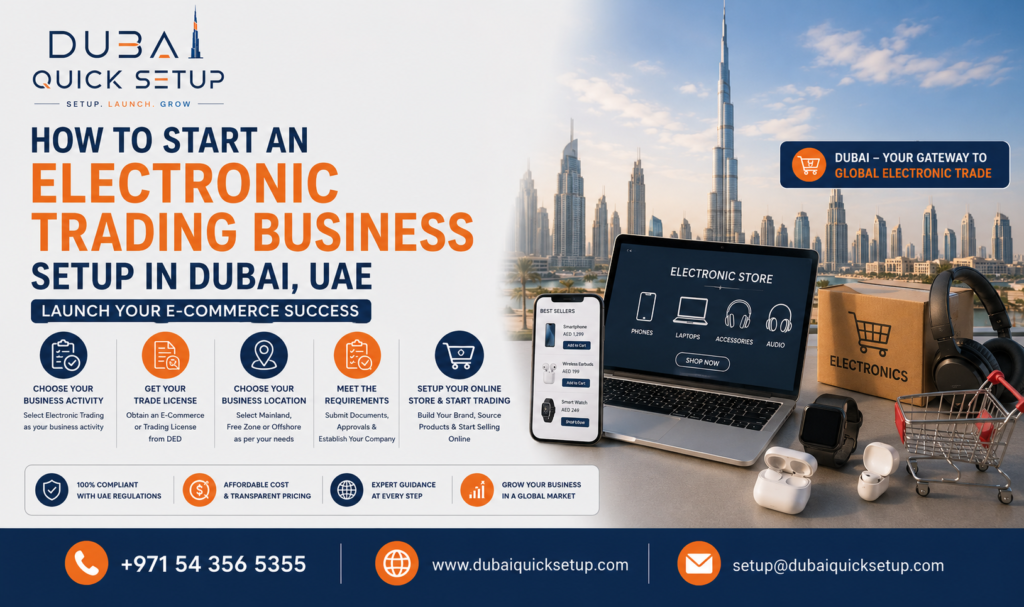
Dubai has become one of the Middle East’s most attractive markets for electronics, consumer technology, IT equipment, and smart devices. With strong purchasing power, international connectivity, advanced logistics infrastructure, and access to customers across the UAE and wider GCC, the emirate offers an appealing environment for entrepreneurs planning an Electronic Trading Business Setup in Dubai and looking to enter the growing electronic trading sector.
An electronic trading business setup in Dubai can cover a wide range of activities, including the wholesale and retail trading of mobile phones, computers, laptops, accessories, networking equipment, consumer electronics, smart home products, electronic components and other technology products.
However, starting an electronics trading company is not simply a matter of obtaining a trade licence and renting a shop. The business activity, jurisdiction, product categories, premises, import requirements, customs registration, visas, taxation and supplier relationships all need to be considered before you launch.
This guide explains how to start an electronic trading business in Dubai, including the licence, estimated setup costs, documents, process, business structure, taxes, warehouse requirements and practical considerations for 2026.
Important: Government fees, office requirements, visa costs, and free-zone packages may vary depending on the authority, business activity, number of shareholders, facility requirements, and visa quota. The figures below are practical planning estimates rather than a fixed government tariff. A final quotation should be obtained after confirming the exact activity and jurisdiction.
What Is an Electronic Trading Business in Dubai?
An electronic trading business buys, sells, imports, exports, distributes or wholesales electronic products and technology-related goods.
Depending on the approved activity, an entrepreneur may build a business around:
- Mobile phones and smartphones
- Laptops and desktop computers
- Computer accessories
- Printers and scanners
- Networking equipment
- Routers and switches
- CCTV and security-related equipment
- Smart home devices
- Consumer electronics
- Audio and video equipment
- Gaming accessories
- Electronic components
- Chargers and cables
- Wearable technology
- IT hardware
- Office electronics
- Electronic spare parts
- Other approved technology products
The exact activity should be selected carefully because your licence determines what your company is legally permitted to conduct.
Dubai’s official business portal provides a searchable database for business activities, including trading-related activities, which makes activity verification an important part of the company formation process.
Why Start an Electronics Trading Business in Dubai?
Dubai is strategically positioned between major markets in Asia, Europe and Africa. For electronics traders, this creates opportunities beyond the local retail market.
1. Large consumer market
Dubai has a diverse population with strong demand for smartphones, computers, home technology, gaming products and other electronics.
2. International trading hub
The emirate’s ports, airports, logistics providers and free zones support international import and export operations.
3. B2B and B2C opportunities
An electronics company does not have to depend only on walk-in customers.
You can sell through:
- Retail stores
- E-commerce websites
- Marketplaces
- Social media
- Corporate contracts
- Wholesale distribution
- Resellers
- IT companies
- Contractors
- Hospitality businesses
- Schools and educational institutions
- Government and private-sector procurement
4. Re-export opportunities
Dubai can also serve as a base for exporting or re-exporting electronics to GCC, African and Asian markets.
5. Foreign investor opportunities
The UAE permits full foreign ownership for many mainland commercial companies, subject to the applicable activity and regulatory requirements. The UAE Government provides dedicated guidance on foreign ownership and mainland company formation.
Electronic Trading Business Licence in Dubai
For most conventional electronics trading businesses, the appropriate licence will generally fall under the commercial trading licence category, with the exact economic activity selected according to the products you intend to trade.
The important point is that there is not necessarily one universal licence called an “electronics licence.”
Instead, your company needs an approved economic activity that accurately reflects the products and trading operations of the business.
Dubai’s Invest in Dubai platform allows entrepreneurs to search business activities and licence information before proceeding with the application.
What Does a Commercial Licence Allow?
A commercial licence is generally used for businesses involved in buying and selling goods.
For an electronics trading company, the licence structure may be designed around approved activities relating to the relevant electronic products.
Depending on your business model, you may also need to consider additional approvals or requirements for specific regulated products.
For example, businesses dealing with certain telecommunications, radio, wireless, security or other regulated equipment should verify whether additional approvals are applicable before importing or selling those products.
Mainland vs Free Zone for Electronics Trading
One of the first decisions you need to make is whether to establish your electronics trading company in Dubai Mainland or a Dubai/UAE Free Zone.
Dubai Mainland
A mainland company can be attractive if your primary objective is to sell directly throughout the UAE market, operate a physical retail outlet or build a local distribution business.
Advantages
- Ability to target the UAE mainland market
- Suitable for retail and wholesale operations
- Greater flexibility for physical business locations
- Suitable for local B2B sales
- Can support expansion into multiple commercial activities where permitted
- Access to the wider Dubai business ecosystem
The UAE Government provides dedicated procedures and information for setting up and operating mainland companies.
Free Zone
A free zone company may be attractive when your model focuses on:
- Import and export
- Re-export
- International trading
- Wholesale distribution
- E-commerce
- Logistics
- Lower-cost startup structures
- Operating from a free-zone warehouse or office
However, the exact ability to conduct sales into the UAE mainland depends on the applicable rules, structure and arrangements.
Which Is Better?
There is no universal answer.
If your plan is:
Dubai retail store + UAE customers + local distribution: mainland may be more suitable.
If your plan is:
Import + export + re-export + international distribution: a suitable free zone may be worth considering.
Dubai Quick Setup can assess your product range, sales model, warehouse requirements and target market before recommending the appropriate jurisdiction.
Electronic Trading Business Setup Cost in Dubai
One of the most common questions entrepreneurs ask is:
“How much does it cost to start an electronics trading business in Dubai?”
The answer depends heavily on the jurisdiction and business model.
A small trading company without a physical shop can have a very different startup budget from an electronics retailer requiring a showroom and warehouse.
Estimated Initial Setup Budget
| Expense | Estimated Cost |
|---|---|
| Trade name and initial approval | AED 600 – 1,500 |
| Commercial licence and government charges | AED 8,000 – 18,000+ |
| Memorandum/formation documentation | AED 1,000 – 3,000 |
| Office/flexi-desk or business centre | AED 5,000 – 20,000+ |
| Tenancy/registration-related costs | AED 1,000 – 5,000+ |
| Establishment/immigration card | AED 700 – 2,500 |
| Investor/employee visa per person | AED 3,000 – 7,000+ |
| Emirates ID and medical-related costs | AED 500 – 1,000+ |
| Customs/import registration | Variable |
| Warehouse | AED 15,000 – 100,000+ annually |
| Initial inventory | AED 30,000 – AED 500,000+ |
| Website/e-commerce platform | AED 2,000 – 15,000+ |
| Accounting and compliance | AED 3,000 – 10,000+ annually |
Approximate Small-Scale Startup
A lean electronics trading company using a low-cost office arrangement and limited initial inventory might require approximately:
AED 25,000 – AED 60,000+
Trading Company With Inventory
A company importing and holding substantial inventory could require:
AED 75,000 – AED 250,000+
Retail Electronics Store
A physical electronics shop with showroom fit-out, rent, employees and inventory could easily require:
AED 150,000 – AED 500,000+
These are planning ranges rather than fixed government prices. Inventory, rent and logistics can make a much bigger difference to the total investment than the licence itself.
Electronic Trading Licence Cost in Dubai
For planning purposes, entrepreneurs should generally budget around AED 8,000 to AED 18,000+ for the core mainland commercial licensing and government component, depending on the approved activities, legal structure and government charges.
Free zone packages can sometimes be structured differently and may start lower or higher depending on:
- Number of visa allocations
- Office requirement
- Warehouse requirement
- Number of activities
- Number of shareholders
- Free-zone authority
- Licence package
- Immigration establishment requirements
Therefore, comparing only the headline “licence price” can be misleading.
A package advertised at AED 6,000, for example, may not include office space, immigration establishment, visas, customs registration or other requirements.
Step-by-Step Electronic Trading Business Setup in Dubai
Step 1: Decide What Electronics You Will Trade
Start with the product list.
Do you want to trade:
- Mobile phones?
- Computers?
- Accessories?
- Networking equipment?
- Smart home products?
- Consumer electronics?
- Gaming products?
- Electronic components?
- B2B technology equipment?
Your product list helps determine the correct economic activity and whether additional approvals could apply.
Step 2: Select Mainland or Free Zone
Your sales strategy should determine the jurisdiction.
Ask yourself:
- Where will customers be located?
- Will you import goods?
- Will you export?
- Do you need a warehouse?
- Will you operate a retail shop?
- Do you need multiple visas?
- Will you sell through an e-commerce website?
- Will you supply companies?
- Will you re-export products?
This analysis can prevent you from selecting a cheap licence that later does not match your operational requirements.
Step 3: Choose the Business Activity
This is one of the most important steps.
Dubai’s official Invest in Dubai platform allows users to search activities by activity name or number.
The activity should accurately represent your intended business.
Do not simply select an unrelated low-cost activity because its licence is cheaper.
The wrong activity can create problems with:
- Banking
- Invoicing
- Supplier contracts
- Customs
- Regulatory approvals
- Business expansion
- Compliance
Step 4: Reserve Your Trade Name
Once the business activity and structure are determined, the next stage is selecting an appropriate trade name.
Your name should comply with the applicable naming rules and should not create confusion with another registered business.
Invest in Dubai provides an online service for checking business-name availability.
Step 5: Obtain Initial Approval
Initial approval allows you to proceed with the company formation process subject to the applicable requirements.
Additional approvals may be required depending on:
- Product type
- Business activity
- Location
- Facility
- Regulatory authority
- Import requirements
Step 6: Arrange Office or Warehouse
Your premises requirement depends on your business model.
A small electronics trading company may start with a business centre or suitable office arrangement.
A larger importer may require:
- Warehouse
- Storage facility
- Loading/unloading area
- Inventory management
- Logistics access
- Product handling systems
If you are selling high-value electronics, security and insurance should also be considered when selecting your premises.
Step 7: Complete the Commercial Licence
After completing the applicable documentation, premises and approvals, the commercial licence can be issued.
The UAE Government confirms that businesses can use digital channels for company formation and licensing, including the Basher service, which connects relevant government entities for business licensing.
Step 8: Apply for Immigration Establishment
If you plan to employ staff or obtain investor/employee visas, the company will generally need the appropriate immigration establishment setup.
Visa costs depend on:
- Visa type
- Applicant status
- Inside/outside UAE application
- Medical examination
- Emirates ID
- Government charges
- Processing requirements
Step 9: Open a Corporate Bank Account
After incorporation, the company can approach UAE banks for a corporate account.
Banks may request:
- Trade licence
- Certificate of incorporation
- Memorandum/formation documents
- Shareholder information
- Passport copies
- Emirates ID
- Business plan
- Source of funds
- Supplier information
- Expected transaction volume
- Invoices/contracts
Electronics trading companies should maintain clear documentation because banks may want to understand the nature of international trading transactions and expected payment flows.
Step 10: Register for Customs if Importing Electronics
If your company imports products into the UAE, customs registration and import documentation become important.
You should plan for:
- Supplier invoices
- Packing lists
- Shipping documents
- Certificates of origin where required
- HS codes
- Customs declarations
- Product-specific compliance
- Import permits where applicable
Do not assume that obtaining a commercial trade licence automatically gives you every approval required for importing every category of electronic product.
Popular Electronics Products to Import and Export From Dubai
Dubai is particularly attractive for electronics businesses because it can function as a regional distribution centre.
An entrepreneur can potentially source products from:
- China
- Hong Kong
- Japan
- South Korea
- Europe
- India
- United States
- Other international markets
The products can then be:
- Imported into the UAE
- Stored in a warehouse
- Sold within the UAE
- Distributed to regional customers
- Re-exported to other countries
However, importers should carefully verify customs classifications and any product-specific regulatory requirements before shipment.
Documents Required for Electronics Trading Company Formation
Typical documents can include:
Individual shareholder
- Passport copy
- Passport-size photograph
- UAE entry/visa information where applicable
- Emirates ID where applicable
- Contact details
- Business activity information
Corporate shareholder
Additional corporate documents may include:
- Certificate of incorporation
- Memorandum and Articles
- Board resolution
- Shareholder information
- Certificate of incumbency/good standing where required
- Attestation/legalisation depending on jurisdiction
The exact documentation depends on the company’s structure, shareholders and licensing authority.
VAT for an Electronics Trading Business in UAE
VAT should be included in your financial planning from the beginning.
The UAE Federal Tax Authority states that VAT registration becomes mandatory when taxable supplies and imports exceed AED 375,000, while voluntary registration is available above AED 187,500, subject to the applicable conditions.
For an electronics trader, VAT planning is particularly important because the business may have significant:
- Import costs
- Inventory purchases
- Local sales
- B2B transactions
- Logistics expenses
- Operating expenses
A proper accounting system should track input and output VAT accurately.
Corporate Tax for Electronics Trading Companies in Dubai
UAE companies should also consider Corporate Tax obligations.
The Federal Tax Authority provides Corporate Tax registration services through the EmaraTax platform.
Corporate Tax compliance should be assessed according to the company’s legal structure, taxable income, applicable thresholds, exemptions and other rules.
Do not wait until the business becomes profitable before thinking about tax compliance.
Your accountant should establish proper records from the first financial year.
Electronic Trading Business Setup in Dubai: Estimated Timeline
A straightforward company formation can often be completed relatively quickly once the required documents, activity and premises arrangements are clear.
A practical planning timeline may look like:
| Stage | Estimated Time |
|---|---|
| Business consultation | 1 day |
| Activity selection | 1–2 days |
| Trade name | 1–2 days |
| Initial approval | 1–3 days |
| Documentation | 1–3 days |
| Office/tenancy | 1–5 days |
| Licence issuance | 1–5 days |
| Immigration establishment | 2–5 days |
| Visa process | 5–10+ working days |
| Bank account | Depends on bank/compliance |
The exact timeline can vary according to the authority, activity, approvals and completeness of documents.
Electronic Trading Business Setup Cost Calculator
For an initial planning exercise, consider the following example.
Example: Small Electronics Trading Company
Licence and government costs: AED 12,000
Office/business centre: AED 10,000
Immigration establishment: AED 1,500
One investor visa: AED 5,000
Website: AED 5,000
Accounting/compliance: AED 5,000
Initial inventory: AED 50,000
Marketing: AED 10,000
Approximate initial investment:
AED 98,500
This is only an example.
A business operating from a free zone with a lean inventory model could require substantially less, while a physical showroom and warehouse could increase the investment considerably.
Why Choose Dubai Quick Setup for Your Electronics Trading Company?
Starting an electronics trading company involves more than submitting a licence application.
At Dubai Quick Setup, our role is to help entrepreneurs understand the complete company formation process before committing to a structure.
We can assist with:
- Business activity selection
- Mainland company setup
- Free zone company formation
- Commercial licence
- Trade name registration
- Initial approvals
- Office solutions
- Visa processing
- Emirates ID assistance
- Corporate bank account guidance
- Customs-related setup guidance
- Accounting and tax compliance coordination
- Business setup documentation
- PRO services
- Company renewal support
Our approach is straightforward:
Understand the business → Select the right activity → Choose the right jurisdiction → Complete licensing → Prepare for operations.
The UAE Government itself provides digital tools that allow entrepreneurs to search business activities, verify licences and access business formation services.
This makes it especially important to verify the activity and licence rather than relying only on generic package advertisements.
In conclusion, an electronic trading business setup in Dubai can provide entrepreneurs with access to a large UAE consumer market and an international trading ecosystem.
But the strongest businesses start with planning rather than simply purchasing a licence.
Before registering your company, define:
- The electronics you will sell
- Your target customers
- Your suppliers
- Import and export requirements
- Mainland or free-zone structure
- Required business activity
- Office or warehouse requirements
- Visa requirements
- Initial inventory budget
- VAT and Corporate Tax obligations
- E-commerce requirements
- Marketing strategy
A realistic startup budget can range from approximately AED 25,000 for a lean setup to AED 500,000+ for a larger retail/import operation, depending primarily on premises, visas, inventory and operating requirements.
For entrepreneurs who want to avoid unnecessary costs and select the correct structure from the beginning, professional company formation support can make the process considerably easier.
Dubai Quick Setup can help you evaluate your electronics trading model, select the appropriate business activity, compare mainland and free zone options, estimate the complete setup cost and guide you through the licensing process.
Ready to start your electronic trading business in Dubai? Contact Dubai Quick Setup for a tailored company formation and cost assessment based on your products, ownership structure and business model.
Frequently Asked Questions
An electronics trading company will generally require an appropriate commercial trade licence with the relevant approved economic activity. The exact activity depends on the electronic products and business model.
As a planning estimate, the core commercial licensing and government component may fall around AED 8,000–18,000+, but the final amount depends on the authority, activities, legal structure and other requirements.
Foreign investors can establish and own many UAE businesses, subject to the applicable activity and legal requirements. Mainland companies can benefit from the UAE’s foreign-ownership framework.
Yes, subject to the applicable commercial activity, customs procedures and any product-specific regulatory requirements.
Yes, an electronics trading business can incorporate an e-commerce sales model, provided its licensing and activities appropriately cover the intended operations.
VAT registration is mandatory when taxable supplies and imports exceed the applicable AED 375,000 mandatory threshold, subject to UAE VAT rules. Voluntary registration may be available above AED 187,500.
Yes, you can apply for a corporate bank account after incorporation, but the bank will conduct its own compliance and due diligence process. Approval is not automatic.
Potentially, provided the selected economic activity covers the intended products and any additional regulatory requirements are satisfied.
It depends on the business. Mainland can be attractive for direct UAE retail and local distribution, while a suitable free zone may be attractive for import, export, re-export and international trading.

Mohamed Aasik is an SEO Expert in Dubai and the CEO of Shaaz SEO Agency. With over 10 years of experience in search engine optimization, digital marketing, and website strategy, he helps businesses across the UAE and GCC improve their online visibility, generate qualified leads, and achieve sustainable growth.