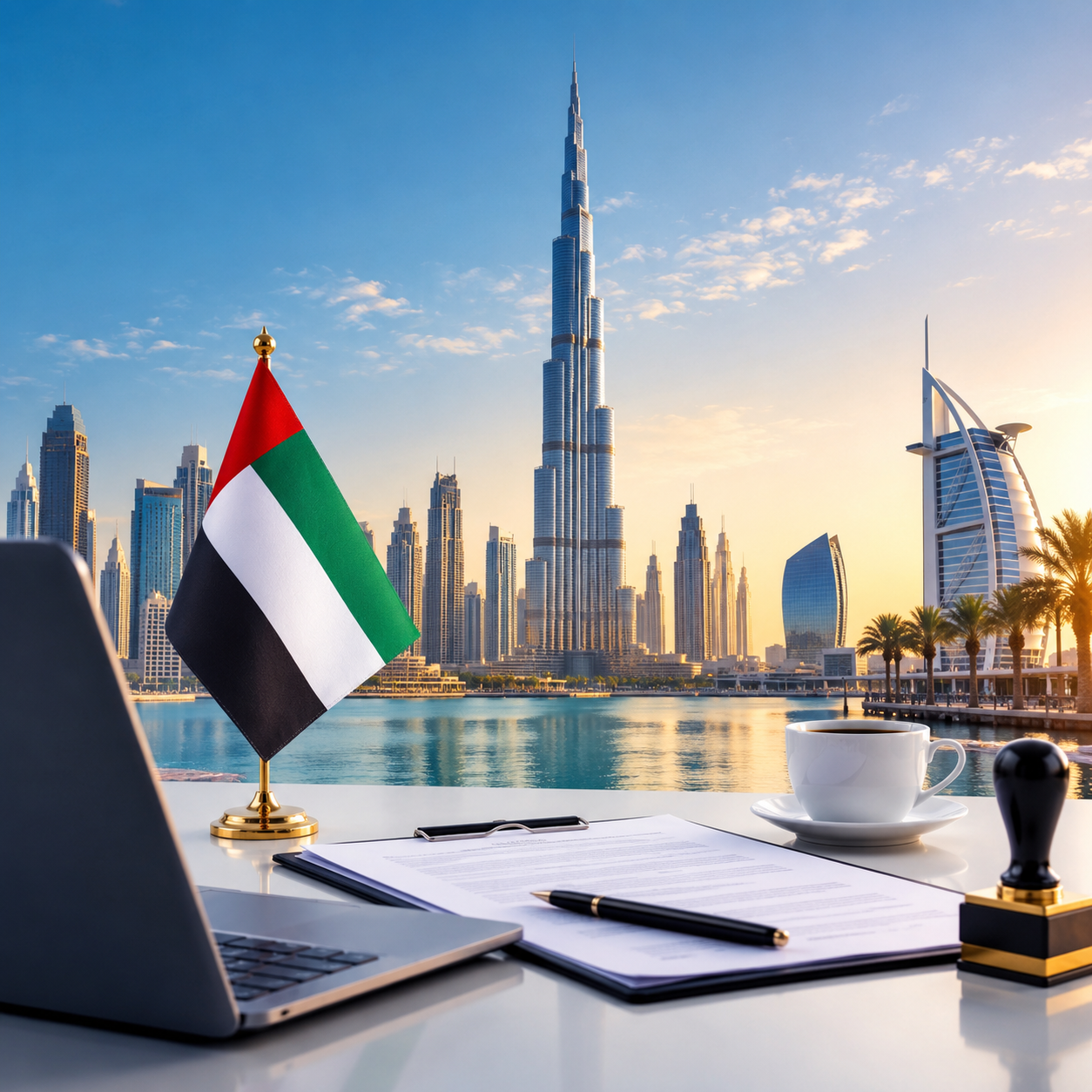
Dubai has become one of the UAE’s most important hubs for food imports, distribution, wholesale, and trade. Starting a Foodstuff Trading Business in Dubai is an attractive opportunity for entrepreneurs due to the emirate’s strategic location between Asia, Europe, Africa, and the Middle East, along with its modern ports, airports, advanced logistics infrastructure, and large consumer market.
If you are planning to start a foodstuff trading business in Dubai, the first step is understanding the difference between simply obtaining a trade license and becoming fully operational. A food trading company may need a commercial license, suitable premises, food-related approvals, product registrations, customs arrangements and, depending on the business model, additional permits.
Dubai’s official investment platform identifies food and agriculture, FMCG, food manufacturing and F&B as important sectors, while highlighting Dubai’s logistics and international trade infrastructure.
This guide explains how to start a foodstuff trading company in Dubai, the foodstuff trading license cost in Dubai, required documents, mainland versus free zone options, food approvals, VAT, corporate tax and the main expenses you should budget for in 2026.
Important: Government fees and total setup costs can change depending on the selected activity, legal structure, jurisdiction, office or warehouse requirements, visa quota, approvals and product category. The cost ranges below are practical planning estimates rather than fixed government quotations. For an exact quotation, the activity and business model should be assessed individually.
What Is a Foodstuff Trading Business in Dubai?
A foodstuff trading business involves purchasing, importing, wholesaling, distributing or selling food products.
Depending on the approved activities, a company may trade products such as:
- Rice and grains
- Flour and cereals
- Pulses and legumes
- Sugar and salt
- Cooking oils
- Spices
- Canned food
- Packaged food
- Frozen food
- Dairy products
- Beverages
- Snacks
- Confectionery
- Dry fruits and nuts
- Meat and poultry products
- Seafood
- Other packaged food products
The exact products your company can trade should be aligned with the business activities and regulatory requirements selected during company formation.
If you intend to import food products into Dubai, the regulatory process can be more extensive than simply obtaining a commercial trade license. Dubai Municipality provides dedicated guidance and services for food traders and establishments, including food establishment requirements, food transportation requirements and food-related permits and approvals.
Why Start a Foodstuff Trading Company in Dubai?
Dubai offers several advantages for food traders.
1. Strategic location
Dubai provides access to major international shipping and air-cargo routes. This makes it practical for businesses importing food products from countries such as India, Pakistan, Turkey, China, Europe, Australia and other global markets.
2. Strong local demand
Dubai has a large population, significant tourism activity and a broad hospitality industry. Food products are required by supermarkets, grocery stores, restaurants, hotels, catering companies and distributors.
3. International trading opportunities
Entrepreneurs can structure their business around local distribution, regional wholesale, import and export or a combination of these activities, subject to the relevant licenses and approvals.
4. Established logistics infrastructure
Dubai’s ports, airports, warehouses, cold-chain facilities and road network support food distribution and import businesses.
5. Foreign ownership opportunities
Dubai’s official investment platform states that foreign investors can enjoy 100% ownership in many mainland sectors, subject to the applicable activity and legal requirements.
Foodstuff Trading License in Dubai
For a typical foodstuff trading company, the main commercial licensing requirement is generally a commercial license covering the appropriate trading activity.
The exact activity should not be selected simply because it contains the word “food.” You need to identify what you will actually do.
For example, there can be significant differences between:
- Foodstuff wholesale trading
- Food import and export
- General food trading
- Beverage trading
- Meat trading
- Frozen food trading
- Dairy product trading
- Specialized food product trading
- Food distribution
- Retail food sales
The Dubai Department of Economy and Tourism provides an official business activity search through Invest in Dubai, allowing entrepreneurs to search activities by name or activity number.
This is important because your license activity determines what your company is legally permitted to conduct.
How Much Does a Foodstuff Trading License Cost in Dubai?
One of the most common questions entrepreneurs ask is:
“What is the foodstuff trading license cost in Dubai?”
There is no single fixed price that applies to every foodstuff trading company.
A practical 2026 planning budget for a straightforward Dubai foodstuff trading company can be approximately:
| Cost Component | Estimated Cost |
|---|---|
| Initial trade license and government-related setup | AED 10,000–18,000+ |
| Trade name / initial approvals and related charges | AED 1,000–3,000+ |
| Office / Ejari or workspace | AED 8,000–30,000+ |
| Immigration establishment-related costs | AED 1,000–3,000+ |
| Investor/employee visa costs per person | AED 3,000–7,000+ |
| Food-related approvals | Depends on activity |
| Warehouse | AED 20,000–100,000+ annually |
| Customs/import registration | Depends on requirements |
| Product registration | Depends on products |
| Professional service/consultancy fees | Depends on provider |
| Initial inventory | AED 20,000–200,000+ |
| Logistics and transportation | Business dependent |
A lean trading setup without a large warehouse or significant initial inventory may therefore start around AED 15,000–35,000+, while a fully operational food import and distribution company with premises, visas, warehouse facilities and inventory can easily require AED 50,000–150,000+ or more.
These figures are planning ranges rather than official fixed fees.
The biggest mistake is to look only at the license price.
A foodstuff trading company is an operational business. Your real investment may include inventory, warehouse space, transportation, customs, product registration, visas, staff and working capital.
Foodstuff Trading Business Setup Cost in Dubai: Main Expenses
Let’s break down the costs in more detail.
1. Trade License Cost
The commercial license is the foundation of your company.
Your final license cost depends on:
- Business activity
- Legal structure
- Mainland or free zone
- Number of activities
- Office requirements
- Government fees
- Name reservation
- Initial approval
- External approvals
- Immigration requirements
For planning purposes, many entrepreneurs should budget AED 10,000–18,000+ for the core licensing and formation side of a straightforward structure, before adding major premises, warehouse, visa and inventory costs.
Do not treat this as a universal government fee.
The official Invest in Dubai platform should be used to verify the relevant licensing route and activity.
2. Office Cost
A mainland company may need premises that meet the requirements associated with its business activity and licensing structure.
For a small trading company, the office requirement may be considerably different from a business operating a warehouse or physical food distribution facility.
Budget approximately AED 8,000–30,000+ per year for a basic office arrangement, depending on location, size and property.
Prime Dubai locations can be considerably more expensive.
3. Warehouse Cost
A warehouse is one of the most significant expenses for a food distribution business.
You may need a warehouse if you are:
- Importing food in bulk
- Holding inventory
- Supplying supermarkets
- Supplying restaurants
- Distributing frozen food
- Handling temperature-sensitive products
- Operating a wholesale distribution model
Warehouse costs can range from approximately AED 20,000 to AED 100,000+ annually, depending on location, size, specifications and whether cold storage is required.
Cold-chain facilities can substantially increase operating costs.
4. Food Product Registration Costs
Food products may require registration or compliance procedures before they can be imported or sold.
Dubai Municipality provides food-related services and requirements for food traders and establishments. Its official resources include food establishment requirements, food transportation guidance and food-related permits and approvals.
Dubai Municipality has also provided services for consumer product registration through its systems, including the Montaji platform.
The exact requirements depend heavily on:
- Product category
- Country of origin
- Ingredients
- Packaging
- Labeling
- Shelf life
- Storage requirements
- Whether the product is processed, fresh, frozen or packaged
Therefore, product registration should be assessed before importing your first shipment.
Mainland vs Free Zone for Foodstuff Trading in Dubai
One of the most important decisions is choosing between Dubai mainland company formation and a Dubai free zone company.
Dubai Mainland Foodstuff Trading Company in Dubai
A mainland structure is often attractive when the business plans to sell directly to customers and businesses across Dubai and the UAE.
Potential advantages include:
- Wider local market access
- Ability to establish a Dubai-based trading operation
- Flexibility for local distribution
- Access to customers across the UAE
- Suitable structure for wholesale and distribution models
Dubai’s official investment platform describes mainland companies as operating both within and outside the UAE, with DET managing mainland registration and licensing.
For a food distributor supplying supermarkets, restaurants, hotels and grocery businesses throughout the UAE, mainland can be a practical option.
Dubai Free Zone Foodstuff Trading Company in Dubai
A free zone may be attractive for entrepreneurs focused on:
- Import and export
- International trading
- Re-export
- Regional distribution
- Cost-conscious startup structures
- Specific logistics ecosystems
However, you should not assume that a free zone company can automatically conduct every type of direct mainland trading activity without additional requirements.
Invest in Dubai specifically notes that free zone companies cannot trade within the UAE without the appropriate mainland arrangement or license.
Therefore, your intended sales model should be decided before selecting the jurisdiction.
Documents Required for Foodstuff Trading Company Formation in Dubai
The exact documentation depends on your legal structure and licensing authority, but commonly required documents can include:
- Passport copies of shareholders
- Passport copy of manager
- Passport-size photographs where required
- Proposed company names
- Business activity details
- Application forms
- Memorandum of Association where applicable
- Address or tenancy documentation
- Ultimate beneficial owner information
- Corporate documents for corporate shareholders
- Additional documents for specific regulated activities
For tax registration, the Federal Tax Authority may request documents including the trade license, commercial registration documents, incorporation documents, Emirates ID and passport information of relevant owners or authorised signatories.
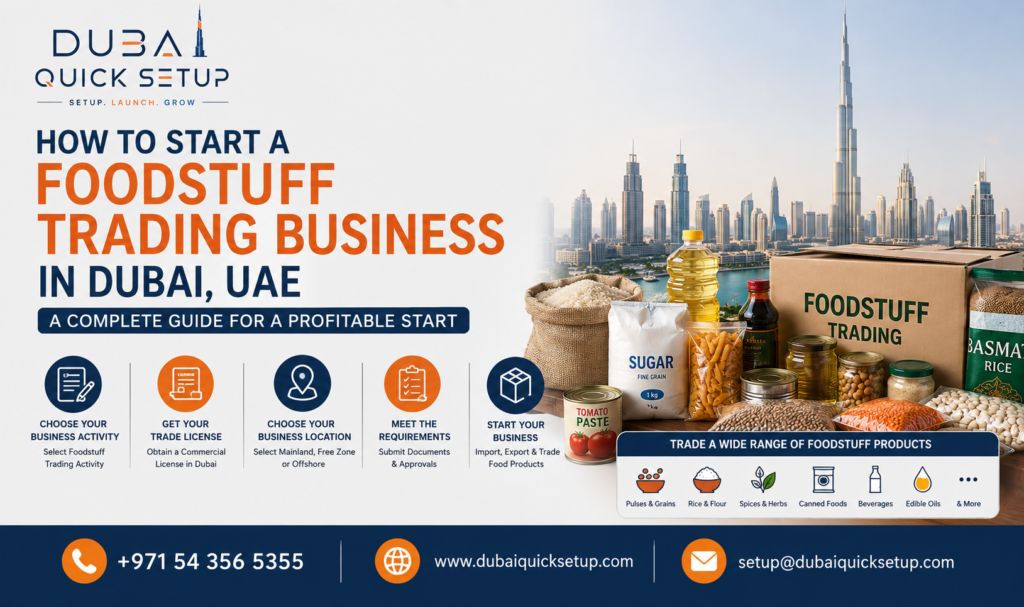
Step-by-Step Process to Start a Foodstuff Trading Business in Dubai
Step 1: Choose Your Food Trading Activity
First, define exactly what you will trade.
For example:
“I want to import packaged food from India and distribute it to supermarkets and restaurants in Dubai.”
This is much more useful than simply saying:
“I want a food business.”
Your product category determines your licensing and approval requirements.
Step 2: Select Mainland or Free Zone
Decide whether your business needs:
- Dubai mainland
- Dubai free zone
- Import/export-focused structure
- Warehouse-based operation
- Local distribution
Consider your customers before choosing your jurisdiction.
Step 3: Select a Legal Structure
Depending on your situation, you may consider a limited liability company or another permitted legal form.
The appropriate structure depends on:
- Number of shareholders
- Ownership
- Business activity
- Residency requirements
- Corporate structure
- Expansion plans
Step 4: Reserve the Trade Name
Choose a compliant company name and reserve it with the relevant authority.
Avoid names that:
- Mislead customers
- Violate public policy
- Conflict with existing businesses
- Use protected names without permission
Step 5: Obtain Initial Approval
Submit the necessary application and documents for initial approval.
Initial approval does not necessarily mean that every food-related operational approval has been completed.
This distinction is important.
Step 6: Secure Your Business Premises
Depending on your business model, you may need:
- Office
- Warehouse
- Food storage facility
- Cold storage
- Distribution facility
The premises should be suitable for the business activity and meet applicable requirements.
Step 7: Obtain the Commercial License
After completing the licensing requirements, your company can receive its commercial license.
The license should clearly cover the activities your company intends to conduct.
Step 8: Complete Food-Related Approvals
This is where food trading differs from many ordinary trading businesses.
Depending on the products and operation, you may need food-related registrations, permits, establishment approvals, product approvals and transportation compliance.
Dubai Municipality’s official food trader resources provide food establishment requirements and food-related permits and approval information.
Step 9: Register for Customs Where Applicable
If you plan to import food into the UAE, customs registration and import procedures become part of the business process.
You should establish:
- Importer details
- Customs documentation
- HS codes
- Supplier invoices
- Country-of-origin documentation
- Shipping documentation
- Product documentation
Your customs and logistics arrangements should be established before your first commercial shipment.
Step 10: Register for VAT When Required
VAT is an important part of operating a foodstuff trading company.
According to the Federal Tax Authority, a UAE-resident business must register for VAT when its taxable supplies and imports exceed AED 375,000 over the previous 12 months or are expected to exceed that amount within the next 30 days. Voluntary registration is available above AED 187,500, subject to the applicable rules.
This means you should monitor turnover from the beginning rather than waiting until the end of the year.
VAT registration through the FTA is submitted through the EmaraTax platform.
Corporate Tax for Foodstuff Trading Companies in Dubai
UAE businesses also need to consider Corporate Tax compliance.
The Federal Tax Authority states that taxable persons are required to register for Corporate Tax in accordance with UAE Corporate Tax legislation and applicable implementing decisions.
For companies, corporate tax registration and compliance should be considered as part of the business setup and ongoing accounting process.
Do not confuse:
- Trade license
- VAT registration
- Corporate Tax registration
These are separate regulatory requirements.
Food Labeling Requirements in Dubai, UAE
Food labeling is another area where new food traders need to be careful.
Depending on the product, labels may need to provide information such as:
- Product name
- Ingredients
- Allergens where applicable
- Net weight
- Country of origin
- Production information
- Expiry date
- Storage instructions
- Manufacturer/importer information
- Other required declarations
The exact labeling requirements depend on the product and applicable UAE regulations.
Do not print thousands of labels before confirming compliance.
A labeling error can create unnecessary costs, delays and potential shipment problems.
Can You Import Food Products With a Dubai Foodstuff Trading License?
Potentially, yes, provided your licensed activities, approvals, product compliance, customs arrangements and other applicable requirements permit the intended import activity.
But obtaining a commercial license does not automatically mean every food product is approved for import.
You should separately evaluate:
- Company licensing
- Food establishment requirements
- Product registration
- Label compliance
- Importer/customs registration
- Shipping documents
- Storage requirements
- Transportation requirements
Dubai Municipality specifically provides guidance covering food traders, food establishments and food transportation.
What Food Products Can You Trade in Dubai, UAE?
The answer depends on the approved activities and regulatory requirements.
Common foodstuff trading categories include:
Dry Food Trading
- Rice
- Pulses
- Flour
- Spices
- Sugar
- Grains
- Dry fruits
Packaged Food Trading
- Biscuits
- Snacks
- Cereals
- Canned products
- Sauces
- Ready-to-eat products
Beverage Trading
- Bottled beverages
- Juices
- Non-alcoholic drinks
- Specialty beverages
Frozen Food Trading
- Frozen vegetables
- Frozen seafood
- Frozen meat
- Frozen prepared foods
Dairy Products
- Milk
- Cheese
- Yogurt
- Butter
- Other dairy products
Some categories may have additional requirements, so entrepreneurs should not assume that one generic food trading approval covers every product.
How Much Capital Do You Need to Start?
Your required capital depends on the business model.
Small Foodstuff Trading Company
A small business focusing on limited products and local wholesale may require approximately:
AED 25,000–50,000+
This could cover basic licensing, office arrangements, visas and initial working capital, but inventory and operational requirements can push the total higher.
Medium Food Distribution Business
A company maintaining inventory and supplying multiple customers may require:
AED 50,000–150,000+
Import and Wholesale Business
An importer bringing products into Dubai in commercial quantities may require:
AED 100,000–300,000+
This can include:
- Licensing
- Warehouse
- Staff
- Vehicles
- Initial inventory
- Shipping
- Customs
- Product registrations
- Working capital
There is therefore no single answer to “How much does it cost to start a foodstuff trading business in Dubai?”
Your inventory and logistics strategy can be more expensive than your trade license.
Foodstuff Trading Business Profitability in Dubai
Food trading can be profitable, but margins vary significantly.
Profitability depends on:
- Product category
- Purchase price
- Supplier terms
- Import costs
- Shipping
- Customs
- Warehouse costs
- Distribution expenses
- Retailer margins
- Competition
- Product shelf life
- Sales volume
A business selling high-volume commodity products may operate on relatively tight margins but compensate through volume.
Specialty and branded products may offer different margins but can require stronger marketing and distribution.
The key is to calculate landed cost, not just supplier price.
For example:
Supplier price + freight + insurance + customs-related costs + handling + warehouse + distribution = approximate landed cost
Your selling price should then be evaluated against the complete cost structure.
How Dubai Quick Setup Can Help
At Dubai Quick Setup, our approach is to make the company formation process easier for entrepreneurs who want to establish a foodstuff trading business in Dubai.
We can help you evaluate:
- Foodstuff trading activities
- Mainland vs free zone options
- Commercial license requirements
- Company formation documents
- Office requirements
- Visa requirements
- Food-related approvals
- Product registration considerations
- Business setup costs
- Corporate structuring
- Ongoing compliance requirements
Our goal is simple: help you set up your company in Dubai within 3 to 5 working days, subject to the selected jurisdiction, business activity, document readiness, government approvals and any external compliance requirements.
For foodstuff businesses, we focus on the complete setup rather than quoting only a basic license price.
That distinction matters because the right setup depends on whether you are:
- Importing food
- Exporting food
- Wholesaling
- Distributing
- Supplying restaurants
- Supplying supermarkets
- Operating a warehouse
- Trading internationally
A business plan should come before the license application.
Foodstuff Trading License Dubai: Quick Cost Summary
| Requirement | Typical Planning Range |
|---|---|
| Commercial license/setup | AED 10,000–18,000+ |
| Office | AED 8,000–30,000+ |
| Visa per person | AED 3,000–7,000+ |
| Warehouse | AED 20,000–100,000+ |
| Food/product approvals | Activity/product dependent |
| Customs/import setup | Requirement dependent |
| Initial inventory | AED 20,000–200,000+ |
| Transportation | Business dependent |
| Accounting/compliance | Business dependent |
| Total practical startup budget | AED 25,000–150,000+ |
These are indicative planning figures. A business importing large quantities, operating cold storage or maintaining multiple vehicles and employees can require substantially more capital.
Starting a foodstuff trading business in Dubai can be an attractive opportunity for entrepreneurs who understand both the commercial and regulatory sides of the industry.
Dubai offers access to a strong consumer market, international suppliers, logistics infrastructure and regional trading opportunities. However, success depends on choosing the right license activity and building a business model around your actual products and customers.
The biggest financial mistake is focusing only on the Dubai foodstuff trading license cost.
A better approach is to calculate your complete startup budget:
License + office + warehouse + visas + food approvals + product registration + customs + logistics + inventory + working capital.
If you are planning a small wholesale operation, your startup budget may be relatively modest. If you are importing containers of food, operating a warehouse and supplying supermarkets or restaurants, your capital requirements will be considerably higher.
For entrepreneurs who want to establish a foodstuff trading company in Dubai, Dubai Quick Setup can help evaluate the appropriate activity, jurisdiction, licensing requirements and estimated setup cost before you commit to the business.
The objective is not simply to obtain a license. It is to create a legally compliant, commercially practical and scalable food trading business in Dubai.
Frequently Asked Questions
A practical planning estimate for the core licensing and formation side can start around AED 10,000–18,000+, but the actual quotation depends on the activity, jurisdiction, legal structure, premises and government charges.
For many food trading businesses, the relevant license is a commercial license covering the appropriate trading activity. The exact activity should be confirmed through the Dubai licensing system.
Yes, foreign investors can establish companies in Dubai, subject to the applicable business activity, legal structure and regulatory requirements. Dubai’s official investment platform states that 100% foreign ownership is available in many mainland sectors.
Not necessarily for every business model. However, if you import and hold physical food inventory, appropriate storage arrangements may be necessary.
The ability to conduct local UAE sales depends on your jurisdiction, licensing structure and applicable distribution arrangements. A free zone company should not assume unrestricted mainland trading rights.
Food-related businesses can be subject to Dubai Municipality requirements, permits, approvals and food establishment procedures depending on the activity and operation.
The basic company formation process can be relatively fast when documents are ready and the selected activity does not require complex external approvals. However, food approvals, product registration, premises approvals and import arrangements can take additional time.
It can be profitable, but profitability depends on product margins, purchase prices, logistics, inventory turnover, distribution costs and customer payment terms. High-volume food trading often requires careful working-capital management.

Mohamed Aasik is an SEO Expert in Dubai and the CEO of Shaaz SEO Agency. With over 10 years of experience in search engine optimization, digital marketing, and website strategy, he helps businesses across the UAE and GCC improve their online visibility, generate qualified leads, and achieve sustainable growth.