
Dubai has become one of the world’s most attractive destinations for entrepreneurs, investors, startups and international businesses. With its business-friendly environment, strategic location, modern infrastructure and access to international markets, the UAE continues to attract companies from different industries.
Many entrepreneurs choose to establish businesses in Dubai free zones for benefits such as 100% foreign ownership, industry-specific facilities, and simplified company formation procedures. However, as businesses grow, they often want to expand beyond their free zone and access customers, suppliers, commercial opportunities and government contracts in the Dubai mainland market.
Previously, free zone companies faced additional licensing and regulatory considerations when conducting business activities outside their designated free zone. To make business expansion easier, Dubai introduced a new regulatory framework through Executive Council Resolution No. 11 of 2025.
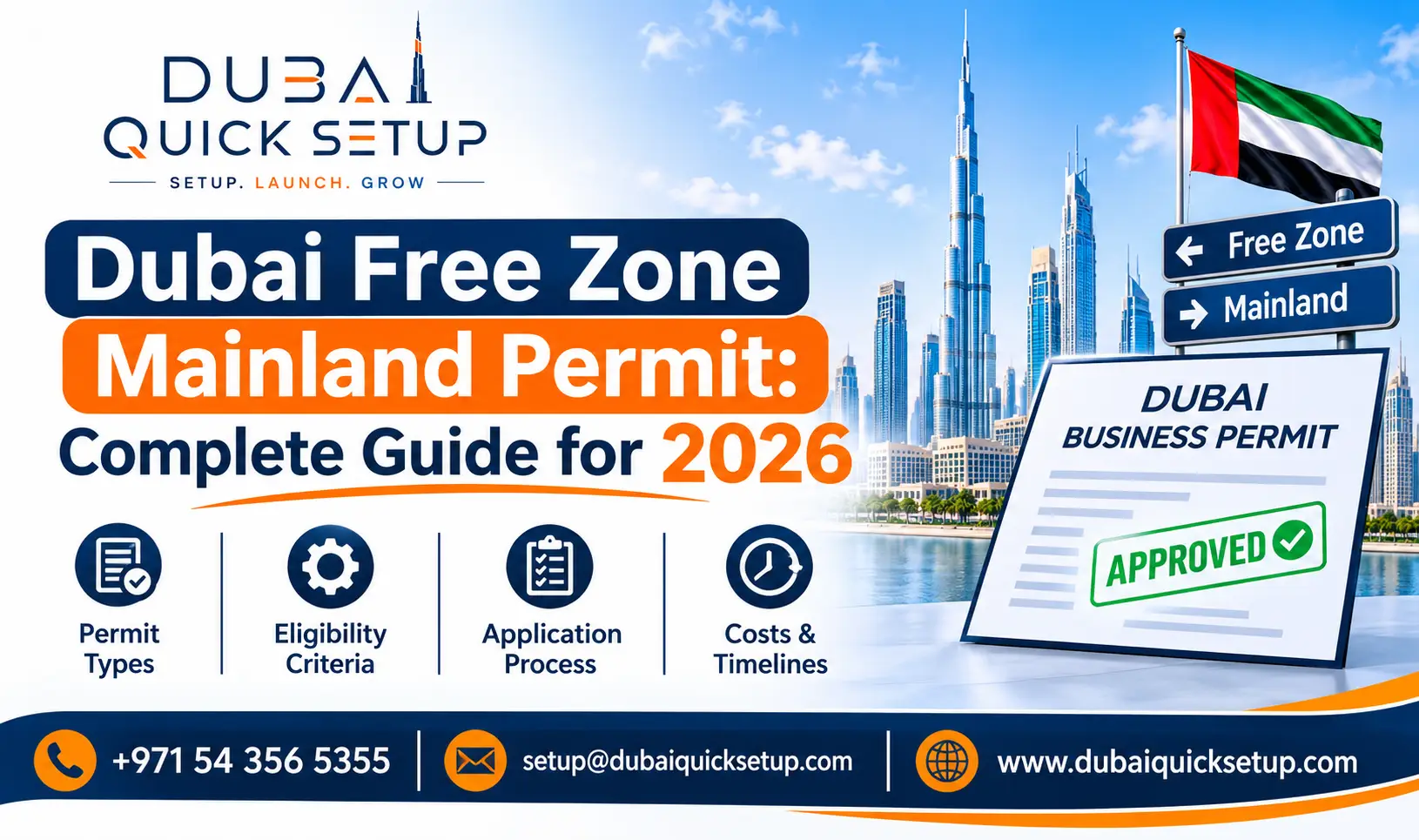
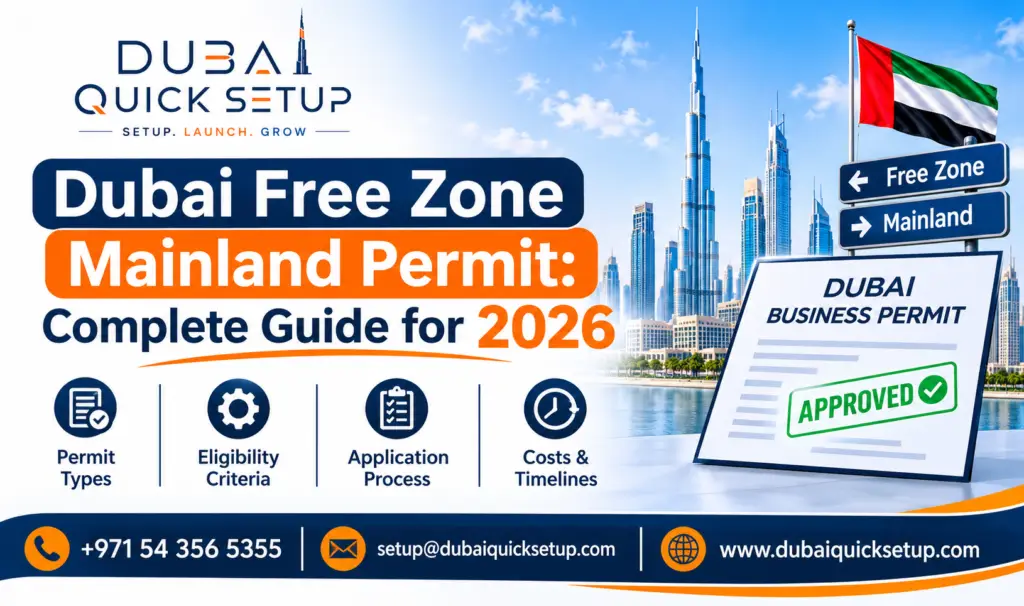
Under this framework, eligible free zone companies can apply for a Dubai Free Zone Mainland Permit, officially introduced as part of the Free Zone Mainland Operating Permit initiative in October 2025.
This development creates new opportunities for businesses that want to access the mainland market while maintaining their existing free zone company structure.
Whether you operate a consultancy, technology company, trading business, design agency or professional services company, understanding the new permit system can help you plan your expansion more effectively.
In this comprehensive guide, Dubai Quick Setup explains everything you need to know about the Dubai Free Zone Mainland Permit, including eligibility, requirements, application procedures, costs, benefits, permitted activities and important compliance considerations.
What Is a Dubai Free Zone Mainland Permit?
A Dubai Free Zone Mainland Permit is an official authorisation that allows eligible companies established in a Dubai free zone to conduct approved business activities outside their free zone and within Dubai mainland, subject to the applicable regulatory requirements.
The initiative is regulated by the Dubai Department of Economy and Tourism (DET), under the framework introduced through Dubai Executive Council Resolution No. 11 of 2025.
The main purpose of this framework is to make it easier for free zone businesses to expand their operations into Dubai mainland without necessarily establishing an entirely new mainland company.
For example, consider a technology consultancy established in a Dubai free zone. The company may initially provide services to international clients and operate from its free zone office. As the business grows, it may want to serve additional customers located in mainland Dubai.
Under the applicable framework, the company may be eligible to apply for a mainland operating permit to conduct approved activities in Dubai.
The permit can provide a more flexible route for expansion while allowing the business to maintain its existing free zone establishment.
However, it is important to understand that the permit does not automatically authorise every activity or replace all mainland licensing requirements. The business must satisfy the conditions applicable to its specific activity and obtain the correct DET authorisation.
Why Did Dubai Introduce the Mainland Permit?
Dubai introduced this framework to support economic growth, improve regulatory flexibility and provide more opportunities for companies operating within its free zones.
The initiative aims to:
- Help free zone businesses access mainland customers.
- Support domestic trading opportunities.
- Create opportunities to participate in government contracts, subject to tender requirements.
- Simplify business expansion across different jurisdictions.
- Reduce unnecessary duplication of company structures.
- Allow eligible businesses to use their existing workforce.
- Improve cooperation between DET and free zone authorities.
- Support small businesses, startups and multinational companies.
The initiative is also aligned with the Dubai Economic Agenda D33, which aims to double the size of Dubai’s economy by 2033.
For growing businesses, this creates an additional route to explore new markets and commercial opportunities.
Understanding the Three Mainland Licensing Options
One important aspect of the new framework is that it does not provide only one route for every free zone business.
Under Executive Council Resolution No. 11 of 2025, DET can authorise eligible establishments through three different options.
1. Temporary Free Zone Mainland Operating Permit
This option is designed for free zone businesses that want to conduct specific approved activities in Dubai mainland for a limited period.
Key features include:
- Validity of up to six months.
- Published government fee of AED 5,000.
- Renewable for another period, subject to approval and applicable requirements.
- Allows approved activities to be conducted outside the free zone.
- Requires approval from the relevant free zone licensing authority.
- Requires a valid free zone trade licence.
- May require additional government approvals depending on the activity.
This option may be suitable for companies exploring new mainland opportunities, undertaking specific projects or expanding their customer base.
2. Branch Licence Within Dubai Mainland
A free zone company can apply to establish a branch within Dubai mainland.
This option may be appropriate for businesses planning a more permanent physical presence in the mainland market.
Important features include:
- The branch must be located within Dubai mainland.
- DET approval is required.
- Approval from the original free zone authority is necessary.
- Additional government approvals may apply.
- The branch does not have a separate legal personality from its parent company.
- The licence is valid for one year and can be renewed.
A company considering a long-term mainland expansion strategy may find this option more appropriate than repeatedly applying for temporary permissions.
3. Branch Licence Operating Out of the Free Zone
This option allows an eligible free zone establishment to obtain a branch licence for conducting approved activities in Dubai mainland while operating from its free zone base.
This can be useful for businesses that want to expand their commercial reach without necessarily relocating their existing operations.
The main features include:
- One-year licence validity.
- Annual renewal.
- Published government fee of AED 10,000 per year.
- DET approval and free zone authority approval.
- Submission of the required company documents.
- Additional regulatory approvals where applicable.
The most suitable option depends on your business activity, operational requirements, expansion plans and the approvals required by the authorities.
Who Is Eligible for a Dubai Free Zone Mainland Permit?
Not every company registered in the UAE automatically qualifies for this permit.
The framework applies to eligible establishments licensed by free zone authorities in Dubai. Companies must meet the requirements established by DET and the relevant licensing authority.
The October 2025 launch announcement specifically identified eligible free zone companies holding a Dubai Unified Licence (DUL) as applicants for the operating permit through the Invest in Dubai platform.
The following points should be considered before applying.
1. Your Company Must Be Registered in a Dubai Free Zone
The company should be established and licensed by an eligible free zone authority in Dubai.
Examples of Dubai free zone jurisdictions include:
- Jebel Ali Free Zone (JAFZA).
- Dubai Multi Commodities Centre (DMCC).
- Dubai Silicon Oasis.
- Dubai Airport Freezone (DAFZ).
- Dubai Internet City.
- Dubai Media City.
- Dubai South.
- Dubai International Financial Centre (DIFC).
Important: These are examples of Dubai free zone jurisdictions, not a guarantee that every company registered in each jurisdiction qualifies for the same permit. Resolution No. 11 of 2025 expressly excludes financial establishments licensed to operate in DIFC.
2. Your Trade Licence Must Be Valid
The free zone company must maintain a valid trade licence issued by its licensing authority.
An expired, suspended or otherwise invalid licence can prevent the company from meeting the application requirements.
Before applying, check:
- Trade licence expiry date.
- Registered business activities.
- Company status.
- Outstanding regulatory requirements.
- Any restrictions imposed by the free zone authority.
3. Dubai Unified Licence (DUL)
The Dubai Unified Licence provides businesses with a common digital business identity across Dubai.
Eligible companies applying through the new mainland operating permit initiative are required to hold a Dubai Unified Licence.
The DUL helps streamline business identification, government services and regulatory processes.
However, businesses should confirm whether their DUL has been issued and whether their company is eligible to proceed through the Invest in Dubai application process. The DUL rollout has been implemented in stages.
4. Approval from the Free Zone Authority
Your existing free zone authority plays an important role in the application process.
The company must obtain the required approval or no-objection confirmation before proceeding with the relevant DET authorisation.
The authority may review the proposed mainland activities, company licence, establishment details and compliance status.
5. Eligible Business Activities
The requested mainland activities must be permitted under the applicable DET framework.
The initial launch phase identified non-regulated sectors, including:
- Technology services.
- Consultancy services.
- Design services.
- Professional services.
- Trading activities.
These categories should not be interpreted as automatic approval for every activity within them. The exact activity code, regulatory classification and applicable approvals must be checked before submitting an application.
Regulated activities may require additional approvals or a different licensing route.
Which Business Activities Can Be Conducted in Dubai Mainland?
One of the most important considerations when applying for a Dubai mainland permit is the type of business activity you intend to conduct.
The framework was introduced to support eligible non-regulated economic activities and create a structured process for free zone companies to access the mainland market.
However, business owners should not assume that every activity listed on their existing free zone licence will automatically be authorised in mainland Dubai.
The specific activity must be checked against the applicable DET requirements.
Examples of Potentially Relevant Business Sectors
| Business sector | Example activities |
|---|---|
| Technology | Software development, IT consultancy and technology solutions |
| Consultancy | Management, business and operational consultancy |
| Design | Graphic, creative and selected design services |
| Professional services | Eligible business support and professional services |
| Trading | Approved commercial trading activities |
The examples above are illustrative, not a confirmed list of individually approved activity codes.
Can IT Companies Get a Mainland Permit?
Technology businesses are among the sectors highlighted in the initial launch of the initiative.
An eligible free zone IT company may explore mainland access for activities such as software development, IT consultancy, technology support and digital solutions.
For example, a software company established in a Dubai free zone may want to work with mainland companies, offer technology services and participate in commercial projects.
The company should confirm that its exact activity is eligible and that all required approvals are in place before beginning the mainland operations.
Can Consultancy Companies Operate in Mainland Dubai?
Consultancy is another sector identified in the initial framework.
Businesses offering eligible management consultancy, business advisory and operational support services may explore this route.
For example, a management consultancy registered in a Dubai free zone may want to provide services to companies located in Business Bay, Downtown Dubai or other mainland commercial districts.
The appropriate permit or branch licence depends on the approved activity and business model.
Can Trading Companies Apply for a Mainland Permit?
The initial launch announcement also identified trading as one of the covered non-regulated sectors.
However, trading businesses should pay particular attention to product classifications, import requirements, customs procedures and any special approvals.
Trading regulated products or goods subject to additional government controls may require separate permissions.
Before expanding into mainland trading, confirm the product category, activity code, storage arrangements and distribution requirements.
Dubai Free Zone Mainland Permit Requirements and Documents
Preparing the required documentation before starting the application can help reduce unnecessary delays.
The exact document checklist depends on the type of authorisation and the DET application requirements.
Under Executive Council Resolution No. 11 of 2025, a temporary permit application must include documents and information requested by DET, including the company’s memorandum of association and free zone trade licence.
For a practical initial checklist, prepare the following:
| Document | Purpose |
|---|---|
| Free zone trade licence | Confirms the company’s registration and activities |
| Memorandum of Association | Provides company ownership and legal structure details |
| Dubai Unified Licence | Supports business identification and application eligibility |
| Passport copy of the company manager | Identifies the authorised manager |
| Emirates ID of the manager | Supports identity verification where requested |
| Free zone authority approval | Confirms the required approval from the licensing authority |
| Proposed mainland activity details | Explains the activities the company wants to conduct |
| Additional regulatory approvals | Required for activities supervised by other government authorities |
Not every document in this table is mandatory for every permit type. DET may request additional information depending on the company’s legal structure and intended activities.
For branch licences operating out of the free zone, the resolution specifically identifies the memorandum of association, trade licence and manager’s passport and Emirates ID among the documents that may be requested.
How to Apply for a Dubai Free Zone Mainland Permit: Step-by-Step Process
The application process is designed to be digital, helping eligible free zone companies access mainland business opportunities through the relevant government channels.
Eligible companies can apply for the Free Zone Mainland Operating Permit through the Invest in Dubai platform.
Here is a practical step-by-step explanation.
Step 1: Review Your Existing Free Zone Company
Start by reviewing your existing company registration and trade licence.
Check the following:
- Your free zone jurisdiction.
- Current trade licence validity.
- Approved business activities.
- Company ownership and legal structure.
- Company manager details.
- Current office or workspace arrangement.
- Any outstanding compliance requirements.
If your licence is approaching its expiry date, address the renewal requirements before proceeding.
Step 2: Check Your Dubai Unified Licence
Confirm whether your company has received its Dubai Unified Licence.
The DUL provides a unified business identity and supports access to Dubai government services.
If your company has not yet received its DUL, contact the relevant authority to confirm its rollout status and eligibility.
Step 3: Identify the Mainland Activities You Need
Decide exactly which activities you want to conduct in mainland Dubai.
For example:
- Providing IT services to mainland customers.
- Delivering eligible consultancy services.
- Undertaking approved design projects.
- Conducting permitted commercial trading.
- Expanding your existing professional services.
Do not select activities simply because they appear on your existing free zone licence. Confirm whether they are included in the applicable mainland framework.
Step 4: Obtain Free Zone Authority Approval
Contact your free zone authority and request guidance on obtaining the necessary approval or no-objection confirmation.
The authority may review your business activities, company status and proposed expansion.
Make sure that the information submitted to the free zone authority matches the details you intend to provide to DET.
Step 5: Access the Invest in Dubai Platform
Eligible applicants can use the digital platform to access the relevant mainland operating permit services.
The platform provides a government channel for the application process.
Step 6: Submit Your Application
Provide the requested company information and supporting documents.
You may need to provide:
- Company registration information.
- Existing trade licence details.
- Dubai Unified Licence information.
- Company manager details.
- Proposed mainland business activities.
- Required approvals.
- Additional supporting documents requested by DET.
Review all information carefully before submission.
Step 7: Pay the Applicable Government Fees
Once the applicable application requirements and payment instructions are confirmed, pay the prescribed government fees through the approved channel.
For the temporary operating permit, the published fee is AED 5,000 for a period of up to six months.
Step 8: Receive and Review Your Permit
After the relevant authority completes its review, the application may be approved or additional information may be requested.
If approved, carefully review the permit conditions.
Check:
- Approved business activities.
- Permit validity.
- Applicable operating restrictions.
- Renewal requirements.
- Additional regulatory conditions.
Do not begin activities outside your free zone until the required authorisation has been issued and is effective.
Step 9: Maintain Compliance During Mainland Operations
After obtaining the permit, maintain proper business records and comply with the applicable regulations.
The company should also ensure that its activities remain within the approved scope.
The above process is a practical overview, not a guarantee of approval or a fixed processing timeline. Application requirements can vary depending on the company, activity and authority.
Dubai Mainland Permit Cost in 2026
Cost is one of the first things business owners consider before expanding their existing free zone company into mainland Dubai.
The good news is that the new framework provides a published fee structure for temporary permits and certain branch licences.
However, the total cost of expansion depends on the licensing route and any additional requirements.
Official Government Fees
| Licence or permit type | Validity | Published DET fee |
|---|---|---|
| Temporary mainland operating permit | Up to 6 months | AED 5,000 |
| Branch licence operating out of the free zone | 1 year | AED 10,000 |
| Branch licence within mainland Dubai | 1 year | Confirm applicable DET fees |
The resolution expressly specifies AED 5,000 for issuing or renewing a temporary activity permit and AED 10,000 annually for a branch licence operating out of the free zone.
Is the AED 5,000 Permit Renewable?
Yes. The temporary permit can be renewed for a further period, subject to the applicable conditions and approval.
The published launch information identifies a six-month validity period and an AED 5,000 renewal fee.
For example:
| Period | Government permit fee |
|---|---|
| First 6 months | AED 5,000 |
| Next 6 months | AED 5,000 |
| Total for 12 months | AED 10,000 |
Additional Expenses to Consider
The government permit fee is not necessarily the total cost of operating your business.
Depending on your situation, you may also need to budget for:
- Free zone trade licence renewal.
- Free zone office or workspace expenses.
- Government approval charges.
- Professional consultancy fees.
- Accounting and bookkeeping services.
- Corporate tax compliance.
- VAT registration and reporting, where applicable.
- Additional permits for regulated activities.
- Branch registration and operational expenses, where applicable.
Before applying, prepare a complete budget that includes both the mainland permit and your existing free zone business expenses.
Benefits of Getting a Dubai Free Zone Mainland Permit
The new framework offers several potential benefits to companies that want to expand their business operations without immediately creating an entirely separate company.
1. Access to the Dubai Mainland Market
The biggest advantage is the opportunity to conduct approved activities in mainland Dubai.
Businesses can explore new customers, commercial projects and partnerships beyond their free zone.
For example, a company based in DMCC may want to provide eligible services to clients operating in Business Bay, DIFC or Downtown Dubai.
The appropriate DET authorisation can create a structured route for this expansion.
2. Retain Your Existing Free Zone Company
One of the main attractions is the possibility of retaining your existing free zone establishment.
Rather than immediately setting up a completely separate company, eligible businesses can explore the permit or branch routes under the new framework.
This may reduce the complexity of expanding an existing operation.
However, the selected structure must be suitable for the company’s activities and long-term plans.
3. Opportunity to Work with Mainland Customers
Many businesses want to increase their UAE customer base.
A mainland operating permit can help eligible companies access commercial opportunities in mainland Dubai.
This is particularly relevant for consultancy firms, IT service providers, design companies and approved trading businesses.
4. Government Contract Opportunities
Dubai’s announcement highlighted opportunities for eligible businesses to participate in domestic trading and government contracts.
However, obtaining a permit does not automatically qualify a business for every government tender.
Companies must still meet the relevant tender registration, technical, financial and procurement requirements.
5. Continue Using Existing Employees
Another important benefit is workforce flexibility.
Under Article 8 of Executive Council Resolution No. 11 of 2025, an establishment authorised to conduct mainland activities may engage its existing workforce registered on the free zone portal and continue benefiting from applicable free zone employment privileges.
This can help businesses avoid unnecessary recruitment when expanding their services.
6. Support Business Growth and Expansion
The permit can help companies test new commercial opportunities, develop partnerships and explore additional revenue channels.
A free zone consultancy that previously focused on overseas customers may now have an additional route to serve approved mainland business requirements.
This can support long-term Dubai business expansion.
7. More Flexible Business Planning
Businesses can evaluate whether a temporary permit, a branch licence or a separate mainland company is the most suitable option.
This flexibility can help entrepreneurs make decisions based on their expected revenue, customer requirements and operating model.
Dubai Mainland Permit vs Mainland Trade Licence: What Is the Difference?
Many entrepreneurs confuse a mainland operating permit with a regular mainland trade licence.
Although both provide authorisation for business activities, they are not the same.
A mainland trade licence is generally issued to a business established under the mainland licensing framework.
A free zone mainland operating permit, on the other hand, is an additional authorisation for an eligible existing free zone establishment to conduct specified activities in Dubai mainland.
Here is a comparison.
| Comparison | Free zone mainland permit | Mainland trade licence |
|---|---|---|
| Business structure | Existing free zone company | Mainland company |
| Licensing authority | DET authorisation with free zone authority involvement | DET |
| Company formation | Retains eligible existing establishment | Requires mainland company registration |
| Validity | Up to 6 months for temporary permit | Generally renewable annually |
| Published fee | AED 5,000 for temporary permit | Depends on activity and setup |
| Activities | Specifically authorised activities | Activities listed on mainland licence |
| Physical presence | Depends on permit route and conditions | Subject to mainland licensing and premises requirements |
| Workforce | Existing free zone workforce may be used under the framework | Subject to mainland employment requirements |
| Expansion | Suitable for eligible cross-jurisdiction activities | Suitable for a dedicated mainland business |
The right choice depends on how you plan to operate.
If your company needs a dedicated mainland office, broader activity coverage or a long-term mainland structure, a mainland company may be more suitable.
If your company wants to retain its existing free zone establishment and conduct specifically approved mainland activities, the new permit framework may be worth considering.
Free Zone Company Mainland Operations: Important Compliance Rules
Obtaining a Dubai mainland permit is only the first step. Companies must also understand their ongoing legal, financial and operational responsibilities.
1. Maintain Separate Financial Records
Under Article 3 of the resolution, an establishment authorised to conduct activities outside its free zone must maintain separate financial records for mainland activities.
These records must be distinct from the records relating to activities conducted within the free zone.
Businesses should maintain accurate records of:
- Mainland revenue.
- Mainland business expenses.
- Customer invoices.
- Supplier payments.
- Project-related expenses.
- Relevant supporting documents.
- Transactions between business operations, where applicable.
Proper bookkeeping helps businesses understand profitability and meet reporting requirements.
2. Corporate Tax Considerations
Corporate tax is an important consideration when expanding from a free zone into mainland Dubai.
The UAE Corporate Tax regime generally applies a 0% rate to taxable income up to AED 375,000 and a 9% rate to taxable income exceeding AED 375,000, subject to the applicable rules.
Qualifying Free Zone Persons may benefit from a 0% rate on qualifying income if they satisfy the relevant conditions.
However, businesses should not assume that all income earned through a free zone company will automatically remain eligible for the 0% rate after obtaining mainland access.
The official launch announcement states that mainland activities under this initiative are subject to 9% corporate tax on related revenues. Actual corporate tax treatment must be assessed under the applicable federal legislation, including the rules for Qualifying Free Zone Persons, taxable income, qualifying income and any relevant elections.
3. VAT Registration and Compliance
Businesses conducting taxable supplies in the UAE must assess their VAT obligations.
The standard UAE VAT rate is 5%.
VAT registration is generally mandatory when taxable supplies and imports exceed AED 375,000 over the relevant preceding 12-month period or are expected to exceed that threshold within the next 30 days, subject to the applicable rules.
Companies should review their combined business activities and ensure that invoices, VAT returns and accounting records are accurate.
4. Maintain a Valid Free Zone Licence
The mainland authorisation does not replace your original free zone trade licence.
Your company must continue meeting its free zone licensing and renewal requirements.
Keep track of:
- Trade licence expiry.
- Office lease or workspace requirements.
- Employee visa validity.
- Establishment card requirements.
- Free zone reporting obligations.
- Regulatory approvals.
5. Follow Mainland Regulatory Requirements
Companies operating in Dubai mainland must comply with the applicable federal and local legislation.
Some activities may require additional approvals from specialised government authorities.
For example, healthcare, education, transport, financial services and certain other regulated sectors may have additional licensing requirements.
A DET permit should never be treated as a substitute for a specialised sector approval.
6. Audit and Inspection
Article 11 of the resolution provides for audit and inspection of establishments authorised to conduct activities outside their free zone.
Companies must therefore maintain proper records and ensure that their actual operations match the authorised activities.
Non-compliance may lead to administrative measures or penalties under the applicable legislation.
Can a Free Zone Company Work with Mainland Clients Without a Permit?
This is one of the most common questions asked by entrepreneurs establishing companies in Dubai.
The answer depends on the nature of the transaction, the business activity and where the company actually conducts its operations.
A free zone company should not assume that its free zone trade licence automatically authorises every form of business activity in mainland Dubai.
For example, consider these situations:
Scenario 1: International clients
A free zone company provides software development services to customers outside the UAE. Its activities are conducted in accordance with its free zone licence and applicable regulations.
Scenario 2: Mainland business expansion
The same company wants to establish an ongoing mainland operating presence and conduct approved activities within Dubai mainland. It should assess the appropriate DET permit or branch licence.
Scenario 3: Mainland customer contracts
A free zone consultancy receives an enquiry from a mainland company. Before entering into or performing the contract, it should verify whether the proposed activity and manner of delivery require additional authorisation.
Scenario 4: Government contracts
A free zone company wants to participate in a Dubai government tender. It should check the relevant procurement requirements and whether its licensing arrangements permit the proposed work.
The important point is that mainland customer location alone does not answer every licensing question. The actual activity, location of performance, contractual arrangement and regulatory requirements must be considered.
Dubai Free Zone Mainland Permit vs UAE Mainland Business Setup
Entrepreneurs sometimes confuse Dubai’s mainland operating permit with a general UAE-wide business permit.
These are different concepts.
The new framework under Executive Council Resolution No. 11 of 2025 specifically concerns eligible free zone establishments conducting activities outside their free zones but within the Emirate of Dubai.
It does not automatically authorise a Dubai free zone company to operate throughout the UAE.
For example:
- Dubai mainland activities must follow the applicable Dubai DET framework.
- Abu Dhabi mainland activities must comply with Abu Dhabi’s relevant licensing requirements.
- Sharjah mainland activities must comply with Sharjah’s licensing requirements.
- Other emirates have their own applicable regulatory authorities and procedures.
If your business plans to expand into several emirates, you should evaluate the licensing requirements in each location.
This is particularly important for trading, distribution, contracting, consultancy and professional service businesses.
A UAE free zone mainland permit should therefore not be interpreted as a single nationwide operating licence.
Should You Choose a Mainland Permit or Open a New Mainland Company?
The right business structure depends on your expansion objectives.
A temporary mainland operating permit may be a suitable option if your existing free zone company wants to explore approved mainland opportunities without establishing a completely separate business.
However, setting up a dedicated mainland company may be more appropriate for businesses that require:
- A permanent mainland commercial presence.
- A broader range of mainland activities.
- A dedicated mainland office.
- Long-term mainland operations.
- Specific regulatory or procurement arrangements.
- A different ownership or operational structure.
Example: Choosing the Right Business Structure
Imagine you own a free zone digital marketing consultancy.
Your company currently operates from a Dubai free zone and serves international customers.
You now want to expand your services to mainland businesses in Dubai.
You could evaluate the following options:
Option A: Temporary operating permit
If your activities are eligible, you may apply for the temporary permit to conduct approved activities in mainland Dubai.
Option B: Branch licence
If you want a more permanent mainland operating structure, you can explore the applicable branch licensing options.
Option C: New mainland company
If your expansion requires a separate mainland business structure or additional activities, establishing a new mainland company may be more appropriate.
At Dubai Quick Setup, we recommend evaluating the intended business activity, operational requirements and total setup costs before choosing a licensing route.
How Dubai Quick Setup Can Help with Dubai Free Zone Mainland Permit
Expanding a business into Dubai mainland requires careful planning, correct licensing and an understanding of the relevant government procedures.
Dubai Quick Setup provides business setup assistance for entrepreneurs, investors, startups and established companies planning to establish or expand their businesses in the UAE.
Whether you are starting a new company or exploring mainland expansion for an existing free zone establishment, our team can help you understand the available options.
Our business setup services include:
1. Free Zone Company Formation
We assist entrepreneurs in understanding suitable free zone options based on their business activities, budget and operational requirements.
2. Mainland Company Formation
If a dedicated mainland company is more suitable for your business, we can assist with understanding the registration process, licensing requirements and setup options.
3. Mainland Permit Consultation
We help businesses understand the Dubai Free Zone Mainland Permit framework, identify the appropriate authorisation route and prepare for the relevant application requirements.
Final eligibility and approval remain subject to DET and the relevant free zone authority.
4. Trade Licence Assistance
We assist entrepreneurs with understanding trade licence requirements, selecting appropriate business activities and identifying the relevant licensing authority.
5. Visa and Immigration Services
We provide guidance on business-related visa processes, including investor, partner and employee visa requirements, subject to the applicable immigration rules.
6. PRO Services
Our PRO assistance covers business-related government documentation and administrative processes.
7. Corporate Bank Account Assistance
We help businesses understand the documentation and requirements involved in opening a corporate bank account.
Bank account approval remains subject to the bank’s independent compliance and eligibility checks.
Why Choose Dubai Quick Setup?
- Business setup assistance across Dubai and the UAE.
- Guidance on free zone and mainland company formation.
- Support with trade licence requirements.
- Assistance with visa and PRO processes.
- Business expansion consultation.
- Transparent guidance on government requirements.
- Solutions based on your business activities and budget.
If you already have a free zone company and want to explore mainland opportunities, contact Dubai Quick Setup to discuss the appropriate licensing route.
Conclusion: Expand Your Business Opportunities with a Dubai Free Zone Mainland Permit
The introduction of the Dubai Free Zone Mainland Operating Permit represents an important development for businesses looking to expand beyond their existing free zone jurisdictions.
Under Executive Council Resolution No. 11 of 2025, eligible companies now have structured options to conduct approved activities in Dubai mainland through a temporary permit or the relevant branch licensing arrangements.
With a published temporary permit fee of AED 5,000 for up to six months, the framework creates another opportunity for businesses to explore mainland operations while retaining their existing free zone establishment.
However, choosing the correct licensing route is essential. Companies should carefully review their business activities, free zone licence, eligibility, government approvals, corporate tax obligations and ongoing compliance requirements.
If you are planning to expand your free zone company into Dubai mainland, Dubai Quick Setup can help you understand your business setup options and navigate the relevant licensing requirements.
Frequently Asked Questions About Dubai Free Zone Mainland Permit
It is an authorisation that allows eligible Dubai free zone companies to conduct specified approved activities in Dubai mainland under the framework introduced through Executive Council Resolution No. 11 of 2025.
The published government fee for the temporary operating permit is AED 5,000 for up to six months. Renewal is AED 5,000 for a further approved period. Other business expenses may apply.
The temporary permit can be issued for a period of up to six months. It may be renewed subject to the applicable requirements and approval.
Yes. Eligible free zone establishments can conduct approved mainland activities after obtaining the appropriate DET authorisation under the applicable framework.
The official launch framework identifies eligible free zone companies holding a Dubai Unified Licence as applicants for the operating permit through Invest in Dubai.
The temporary permit and branch options are designed to allow eligible existing free zone establishments to expand into mainland Dubai without necessarily forming an entirely separate company.
The Dubai Department of Economy and Tourism (DET), through its relevant business registration and licensing processes, administers the framework.
Yes. Article 8 of Executive Council Resolution No. 11 of 2025 allows authorised establishments to engage their existing workforce registered on the free zone portal, subject to applicable requirements.
Trading was identified among the initial non-regulated sectors covered by the initiative. However, the specific trading activity, products and any additional regulatory approvals must be checked.
It depends on your business model. A temporary permit may suit eligible companies seeking limited mainland access, while a dedicated mainland licence may be more suitable for businesses requiring a permanent mainland presence or a different licensing structure.
You can contact Dubai Quick Setup for guidance on business setup options, mainland licensing requirements and the application process.

Mohamed Aasik is an SEO Expert in Dubai and the CEO of Shaaz SEO Agency. With over 10 years of experience in search engine optimization, digital marketing, and website strategy, he helps businesses across the UAE and GCC improve their online visibility, generate qualified leads, and achieve sustainable growth.