
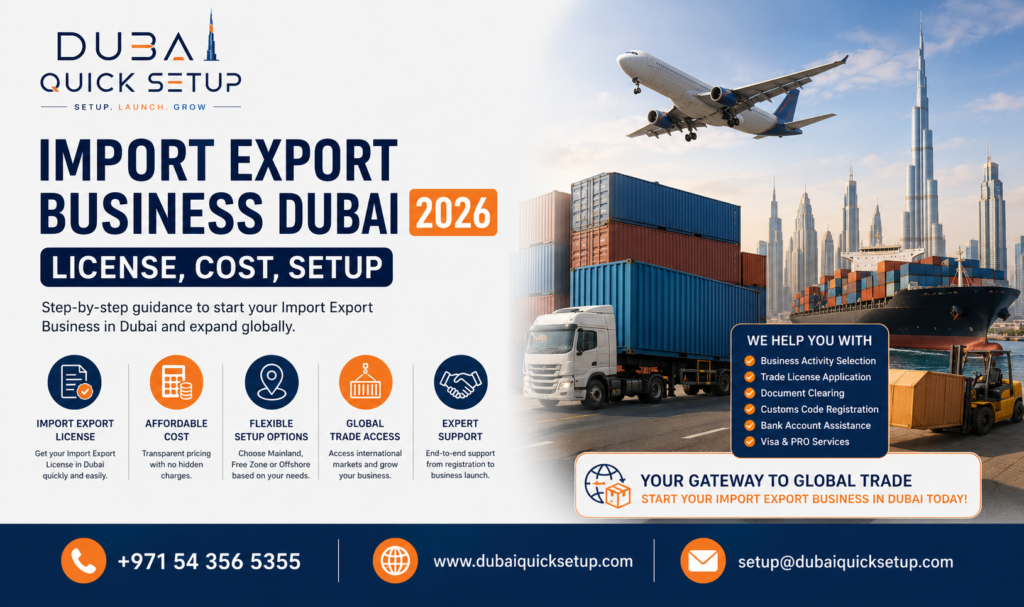
Starting an import export business in Dubai in 2026 can give entrepreneurs access to one of the world’s most connected trading markets. Dubai’s location between Asia, Europe, Africa and the Middle East, combined with its ports, airports, logistics infrastructure and business-friendly environment, makes it a strong base for international trading.
If you are planning an import export business in Dubai, one of the first decisions is choosing the correct business activity and jurisdiction. Your choice affects the type of import export license in Dubai, office requirements, customs registration, visa eligibility, warehouse needs, product approvals and overall setup cost.
In 2026, entrepreneurs can establish an import-export company in Dubai Mainland or in one of the UAE’s free zones. The right structure depends on what you intend to import or export, where your customers are located, whether you need to sell directly in the UAE market, and whether you require warehousing or re-export facilities.
This guide explains the Dubai import export business license, estimated setup costs, requirements, customs registration, taxation, documents, process and practical considerations for starting an international trading company.
Important: Business setup costs vary according to the jurisdiction, business activity, office requirement, number of visas, approvals and products involved. The figures below are practical planning ranges rather than a single government-fixed package price. Always obtain a current quotation before incorporation.
What Is an Import Export Business in Dubai?
An import-export business purchases products from suppliers in one country and sells, distributes or re-exports them to customers in another country.
A Dubai-based trading company can potentially:
- Import goods into the UAE
- Export UAE-origin products
- Re-export products through Dubai
- Purchase products internationally and sell them to overseas buyers
- Distribute imported goods within the UAE, subject to the applicable licence and approvals
- Act as a wholesaler or distributor
- Source products from international manufacturers
- Supply products to retailers and businesses
- Use Dubai as a regional distribution hub
Common sectors include:
- Foodstuff trading
- Electronics trading
- Garments and textiles
- Furniture trading
- Building materials
- Auto spare parts
- Machinery and equipment
- Cosmetics and personal care products
- Industrial products
- General consumer goods
- Packaging materials
- Agricultural products
- Medical equipment, subject to approvals
- Chemicals, subject to applicable regulations
The business activity must be selected carefully. You cannot assume that a general trading licence automatically permits every type of product. Certain products are subject to additional approvals, registration, conformity requirements or sector-specific regulations.
Why Start an Import Export Business in Dubai in 2026?
Dubai offers several advantages for international traders.
The emirate has developed extensive air, sea and road connectivity and provides access to major regional markets. Free zones are also designed to support international trade, including import, export and re-export activities. The UAE government specifically highlights foreign trade as one of the major advantages of free-zone businesses.
Some of the main advantages include:
1. Strategic Location
Dubai connects businesses with markets across the GCC, Middle East, Africa, Asia and Europe.
This makes the city suitable for companies that want to use the UAE as a regional trading or distribution hub.
2. Strong Logistics Infrastructure
Dubai has major sea and air cargo infrastructure, freight forwarders, customs services, warehouses and logistics companies.
3. International Business Environment
Entrepreneurs from different countries can establish companies in Dubai and conduct international business.
4. Free Zone Trading Opportunities
Free zones can be particularly attractive for businesses focused on international trade, re-export and regional distribution.
5. Access to GCC Markets
A Dubai-based business can use the UAE as a base for developing customers and distribution relationships throughout the GCC.
6. 100% Foreign Ownership Options
Many UAE business structures allow full foreign ownership, subject to the applicable activity and jurisdiction rules.
Import Export License in Dubai: What License Do You Need?
One of the most important decisions is selecting the correct import export business license in Dubai.
There is not necessarily a single standalone government document called an “import-export license” that applies to every business. In practice, the company first needs an appropriate commercial/trading activity and license from the relevant licensing authority, followed by customs registration for importing and exporting.
Dubai Customs states that a license holder should obtain a Customs Business Code and use the business code for customs declarations.
Depending on your business model, you may consider:
- Commercial trading license
- General trading license
- Specialized trading license
- Free zone trading license
- Mainland commercial license
- Product-specific trading activities
The correct activity should be selected before applying because the license needs to cover what the company actually intends to trade.
General Trading License vs Specific Trading License in Dubai
One of the most important decisions is whether you need a specific trading activity or a broader general trading structure.
Specific Trading License
A specific trading activity focuses on particular products or product categories.
Examples include:
- Foodstuff trading
- Garments trading
- Electronics trading
- Building materials trading
- Auto spare parts trading
This can be appropriate when your business has a clearly defined product range.
Advantages
- More focused business activity
- Potentially simpler compliance
- Suitable for specialised traders
- Can be more cost-effective depending on jurisdiction
General Trading License
A general trading structure is designed for businesses that want to trade multiple categories of goods, subject to the authority’s permitted activities and restrictions.
It may be useful for entrepreneurs dealing with several unrelated product categories.
However, general trading does not mean every regulated product is automatically permitted.
Certain products can require additional government approvals regardless of the licence structure.
Import Export Business Dubai Cost in 2026
The total import export business setup cost in Dubai depends heavily on your jurisdiction and operating requirements.
A small trading company with a basic office solution and one visa will cost significantly less than a company requiring a warehouse, multiple employees, several visas and specialised product approvals.
A practical planning range for a basic trading company can be approximately:
| Cost Component | Estimated Cost |
|---|---|
| Trade licence and company formation | AED 8,000–25,000+ |
| Business registration/government charges | AED 2,000–6,000+ |
| Office/flexi-desk solution | AED 3,000–15,000+ |
| Establishment/immigration card | AED 1,000–3,000+ |
| Investor/employee visa | AED 3,000–7,000+ per person |
| Medical and Emirates ID | AED 800–1,500+ per person |
| Dubai Customs registration | Official registration fees vary; Dubai Trade currently states AED 100 per business type + AED 20 Knowledge and Innovation fees |
| Product approvals | Depends on product |
| Warehouse | Depends on size/location |
| Customs declarations | AED 15–100 for many declaration types, depending on the transaction/channel |
| Accounting/tax compliance | AED 2,500–10,000+ annually |
| Professional assistance | Depends on service scope |
These figures are planning estimates rather than a fixed government package price.
For example, Dubai Customs currently states that new registration through Dubai Trade costs AED 100 per business type plus AED 20 in Knowledge and Innovation fees.
Dubai Customs also confirms that businesses using Dubai Customs services need to register with Customs.
Dubai Mainland Import Export Business Cost
A mainland company can be attractive when your business model involves direct commercial activity within the UAE.
Your total setup cost can include:
1. Trade Licence
Estimated planning range:
AED 8,000–20,000+
The actual amount depends on the business activity, legal structure and government charges.
2. Office
Depending on your licence and business requirements:
AED 5,000–20,000+ annually
A physical office may become more important when your business needs employees, customers, inventory or operational facilities.
3. Establishment Card
Budget approximately:
AED 1,000–3,000+
4. Visa
Budget approximately:
AED 3,000–7,000+ per applicant
The final amount varies according to visa type and immigration requirements.
5. Customs Registration
A company importing or exporting through Dubai Customs needs the appropriate customs registration.
6. Warehouse
If you maintain inventory, warehouse expenses can become one of the highest operating costs.
Dubai Free Zone Import Export Business Cost
A free zone can be particularly attractive for businesses focused on international trading, re-export, logistics or regional distribution.
The cost varies substantially between free zones.
For example, RAKEZ currently advertises trading business packages from AED 5,499, while noting that additional costs may apply for storage and import/export requirements. RAKEZ also lists warehouse solutions starting from AED 90 per square metre for certain offerings.
DMCC provides another example of the cost structure. Its published company setup information lists an initial application fee of AED 1,035, registration of AED 9,020, an annual licence of AED 20,285 depending on activity, and an annual company card fee of AED 1,825.
DMCC also offers trading, service and industrial licence categories and allows companies to apply for multiple activities or a general trading licence, subject to its rules.
Therefore, when comparing Dubai free zone import export business costs, do not compare only the headline licence price.
Consider the complete package:
- Licence
- Registration
- Establishment card
- Office
- Warehouse
- Visa
- Customs
- Product approvals
- Bank account
- Accounting
- Tax compliance
- Renewal costs
Documents Required for Import Export Business Setup in Dubai
The exact documentation depends on your jurisdiction and company structure, but commonly required documents include:
- Passport copy of shareholders
- Passport-size photographs where applicable
- Proposed company names
- Business activity details
- Application forms
- Memorandum/constitutional documents where required
- Proof of address where requested
- Office tenancy documents where applicable
- Business plan for certain activities or jurisdictions
- Customs registration documents
- Product-related certificates where required
Additional documents may be required for regulated products.
For example, food, cosmetics, pharmaceuticals, medical equipment and certain chemicals may involve additional approvals, registrations or conformity requirements.
Step-by-Step: How to Start an Import Export Business in Dubai
Step 1: Decide What Products You Will Trade
Start with the product rather than the license.
Determine:
- Product category
- Supplier country
- Destination markets
- Expected sales volume
- Wholesale or retail model
- Storage requirements
- Shipping method
- Product approvals
- Customs classification
This prevents you from selecting a license that does not properly cover your intended activity.
Step 2: Select the Business Activity
Choose a trading activity that accurately describes the products or services your company will handle.
If you plan to trade several unrelated product categories, a general trading structure may be considered, subject to the licensing authority’s rules.
Step 3: Choose Mainland or Free Zone
Ask yourself where your customers are.
If your primary business involves international re-export, a free zone may be attractive.
If you intend to distribute extensively within the UAE, mainland setup may provide a more suitable structure.
Step 4: Reserve the Trade Name
Choose an appropriate company name that complies with UAE naming rules.
The name should be available and acceptable to the relevant authority.
Step 5: Apply for the Trade License
Submit the incorporation documents and pay the required fees.
Your license should include the relevant trading activities.
Step 6: Obtain Office or Warehouse Facilities
Your physical requirements depend on the business model.
A small sourcing and trading company may initially need only a modest office.
A company importing containers of products may require a warehouse or third-party logistics facility.
Step 7: Register with Dubai Customs
After obtaining the appropriate license, complete the required customs registration.
Dubai Customs provides dedicated business registration services for this purpose.
Step 8: Open a Corporate Bank Account
Choose a UAE business bank based on:
- Expected transaction volume
- Countries you will deal with
- Currency requirements
- Online banking
- International transfers
- Trade finance requirements
- Letter of credit facilities
- Bank charges
Banks may conduct enhanced due diligence for international trading companies, so maintain clear documentation about your suppliers, customers and business model.
Step 9: Arrange Logistics
Work with reliable freight forwarders, customs brokers, shipping agents and warehouse providers.
Step 10: Start Trading
Once your licensing, customs, banking, logistics and product requirements are properly arranged, you can begin commercial operations.
Import Export Business License Requirements in Dubai
The basic requirements can include:
Valid Business Activity
Your licence must cover the intended trading activity.
Approved Company Name
The name must satisfy the applicable authority’s requirements.
Shareholder Documents
Passport and identification documents are normally required.
Office or Workspace
The requirement depends on the jurisdiction and licence package.
Customs Registration
Required when using the applicable customs services.
Product Approvals
Required for certain categories.
Compliance
The company must comply with applicable tax, customs, corporate and commercial regulations.
VAT for Import Export Businesses in Dubai
VAT is an important consideration for trading companies.
The UAE Federal Tax Authority states that mandatory VAT registration applies when taxable supplies and imports exceed AED 375,000 over the applicable period. Voluntary registration is available above AED 187,500, subject to the applicable rules.
For an import-export business, VAT treatment can become more complicated because transactions may involve:
- Imports
- Local UAE sales
- Exports
- Re-exports
- Zero-rated supplies
- Designated-zone transactions
- Input VAT
- Import VAT
The correct VAT treatment depends on the actual transaction structure.
Businesses should maintain proper:
- Tax invoices
- Customs documents
- Import records
- Export evidence
- Accounting records
- VAT return records
The FTA also states that VAT-registered businesses generally file VAT returns and make related payments within 28 days from the end of the relevant tax period.
Free Zone vs Mainland for Import Export Business
Choosing between mainland and free zone is one of the biggest decisions.
| Factor | Mainland | Free Zone |
|---|---|---|
| UAE market | Strong option | Depends on applicable rules |
| International trading | Yes | Yes |
| Re-export | Yes | Particularly suitable |
| Foreign ownership | Subject to applicable structure | Generally 100% in many zones |
| Warehouse | Available | Often attractive |
| Setup packages | Varies | Wide range |
| Customs | Available | Depends on operating model |
| Office options | Varies | Often flexible |
| Product approvals | May apply | May apply |
| Best for | UAE + international operations | International trade/re-export |
The “best” option depends on your actual business model rather than simply choosing the cheapest licence.
How Much Capital Do You Need to Start an Import Export Business in Dubai?
The licence is only one part of the investment.
A realistic startup budget should consider:
Company formation + licensing + visas + office + customs + banking + product approvals + logistics + inventory + working capital.
For a small service-oriented trading operation with limited inventory, you might structure your initial budget around:
AED 25,000–50,000+
For a trading business requiring inventory, logistics and one or more visas:
AED 50,000–150,000+
For a warehouse-based import-export company:
AED 150,000+
These are broad planning ranges, not official government fees.
The actual investment can be significantly higher if you are importing expensive machinery, vehicles, electronics, food products or other inventory-heavy goods.
Import Export Business Setup Timeline in Dubai
A straightforward company setup can sometimes be completed within a few business days once all required information, documents and approvals are ready.
Dubai Quick Setup generally aims to complete standard company setup procedures within 3–5 days, subject to the selected jurisdiction, activity, documentation and government approvals.
However, customs registration, bank-account opening, visas, warehouse arrangements and product-specific approvals can require additional time.
A practical timeline may look like:
| Stage | Typical Planning Timeline |
|---|---|
| Business consultation | 1 day |
| Activity and jurisdiction selection | 1 day |
| Trade name/application | 1–2 days |
| License issuance | 1–5 business days |
| Customs registration | After licensing; subject to authority processing |
| Corporate bank account | Depends on bank due diligence |
| Visa processing | Additional time if required |
| Product approvals | Varies by product |
| Warehouse/logistics setup | Depends on requirements |
How Dubai Quick Setup Can Help
Dubai Quick Setup helps entrepreneurs and international investors plan and establish businesses in Dubai and the UAE.
Our approach focuses on making the company formation process straightforward—from choosing the appropriate business structure to completing licensing and related setup requirements.
We can assist with:
- Import export business setup
- Commercial trade license
- General trading license
- Mainland company formation
- Free zone company formation
- Business activity selection
- Trade name reservation
- Company registration
- Documentation
- Investor visa assistance
- Employee visa processing
- Office and business setup guidance
- Dubai Customs registration guidance
- Corporate bank account assistance
- VAT registration support
- Corporate tax registration support
- Accounting and compliance support
- License renewal and amendments
Our goal is to help you establish your business efficiently while ensuring that the setup is aligned with your intended commercial activities.
Depending on the selected jurisdiction, business activity, document readiness, government approvals and external compliance requirements, Dubai Quick Setup aims to help clients establish their company efficiently, with many standard setups potentially completed within 3 to 5 working days.
However, regulated activities, product approvals, immigration procedures, banking and external government processes can require additional time.
Why Choose Dubai Quick Setup?
Starting an international trading company involves more than filling out a licence application.
At Dubai Quick Setup, we focus on helping entrepreneurs make the right decisions before spending money.
Business Activity Guidance
We help you identify a suitable trading activity based on your intended products.
Mainland and Free Zone Options
We compare available structures according to your business model.
Transparent Cost Planning
We explain the major components of your setup budget rather than focusing only on the headline licence price.
Customs Guidance
We help you understand the importance of customs registration and import-export procedures.
Visa Assistance
We can assist with the relevant UAE visa process where required.
Corporate Setup Support
Our services can cover the practical steps required to move from business idea to operational company.
In conclusion, starting an import export business in Dubai in 2026 can provide access to one of the world’s most connected commercial and logistics environments. But successful company formation requires more than obtaining a trade licence.
The right import export license in Dubai depends on your products and business model. You also need to consider customs registration, HS codes, product approvals, warehouse requirements, visas, VAT, Corporate Tax, logistics and working capital.
For a small entrepreneur, a specialised trading licence with a flexible office solution may be enough. For a larger international trading company, a free-zone structure with warehousing and logistics facilities may make more sense. Businesses focused on the UAE domestic market may prefer a mainland structure depending on their activities and distribution model.
Dubai Quick Setup can help you evaluate these options before you commit to a particular structure. Our objective is simple: Setup. Launch. Grow. We help entrepreneurs understand the licensing process, compare setup options and build a practical path toward launching their import-export business in Dubai.
If you are planning an import export company formation in Dubai, start by identifying your products, target markets and expected trading volume. Once those details are clear, choosing the appropriate licence and jurisdiction becomes significantly easier.
Frequently Asked Questions About Import Export Business in Dubai
Yes, you need an appropriate business/trading license that authorizes your intended commercial activities, followed by the required customs registration for importing or exporting goods.
Dubai Customs requires license holders to obtain a Customs Business Code for customs transactions.
There is no single fixed price for every company. A basic setup may start around AED 15,000–35,000+, while mainland businesses with offices, visas and additional requirements can cost AED 25,000–60,000+ or more.
Yes. Foreign investors can establish companies in Dubai, subject to the applicable ownership, activity and jurisdiction rules.
Yes. Free zones are specifically designed to facilitate international trade, including import, export and re-export activities.
The process depends on the company’s structure, goods, customs treatment and applicable UAE regulations. You should confirm the appropriate route before importing inventory intended for mainland sale.
Not always. If your company trades a specific product category, a specialized trading activity may be more appropriate. General trading is useful for businesses requiring broader trading activities, subject to licensing rules.
You can apply after incorporation, but the bank will conduct its own compliance and due-diligence process. Approval is not automatic.
Yes. Dubai Quick Setup can assist with company formation, license selection, documentation, visas and related business setup support.

Mohamed Aasik is an SEO Expert in Dubai and the CEO of Shaaz SEO Agency. With over 10 years of experience in search engine optimization, digital marketing, and website strategy, he helps businesses across the UAE and GCC improve their online visibility, generate qualified leads, and achieve sustainable growth.