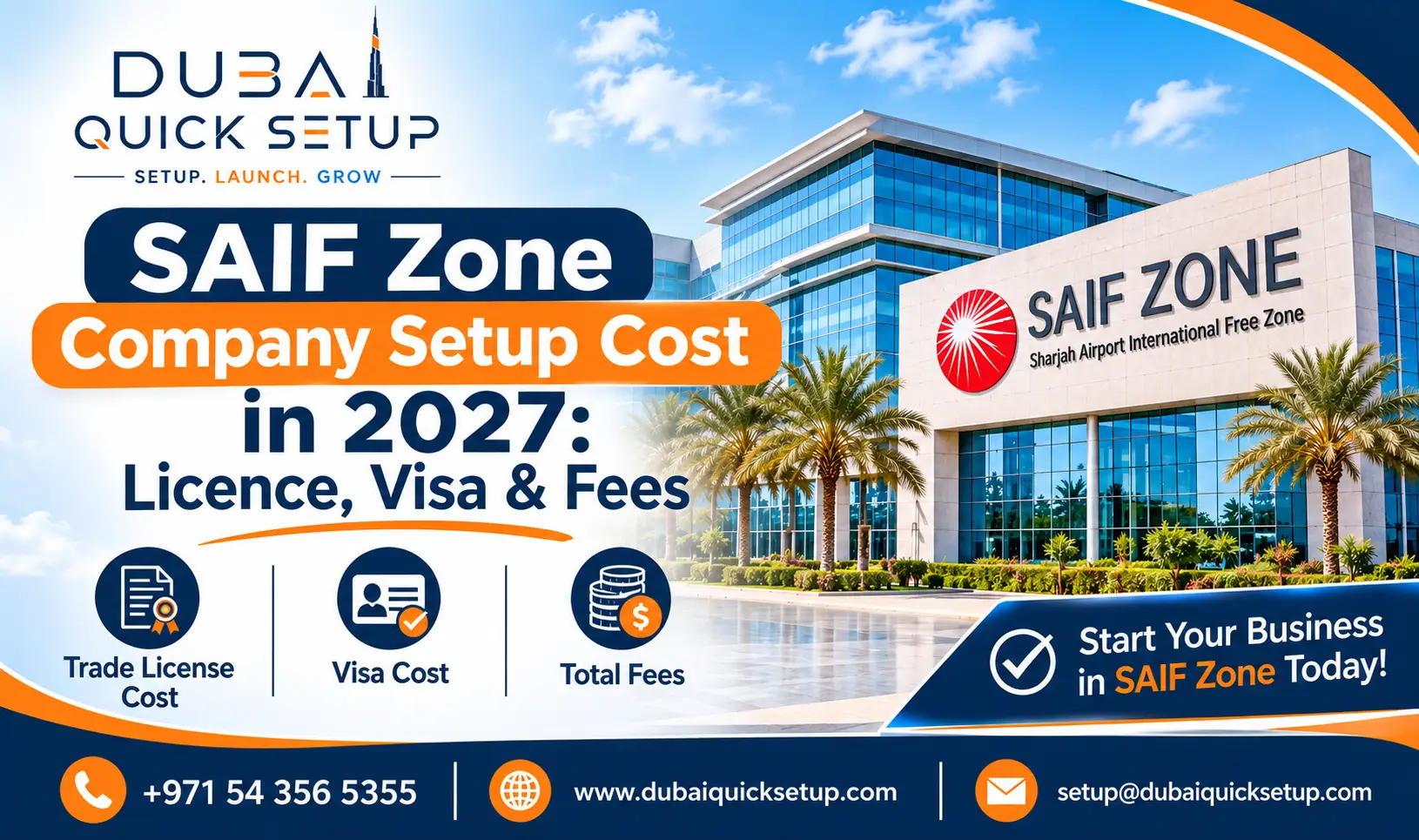

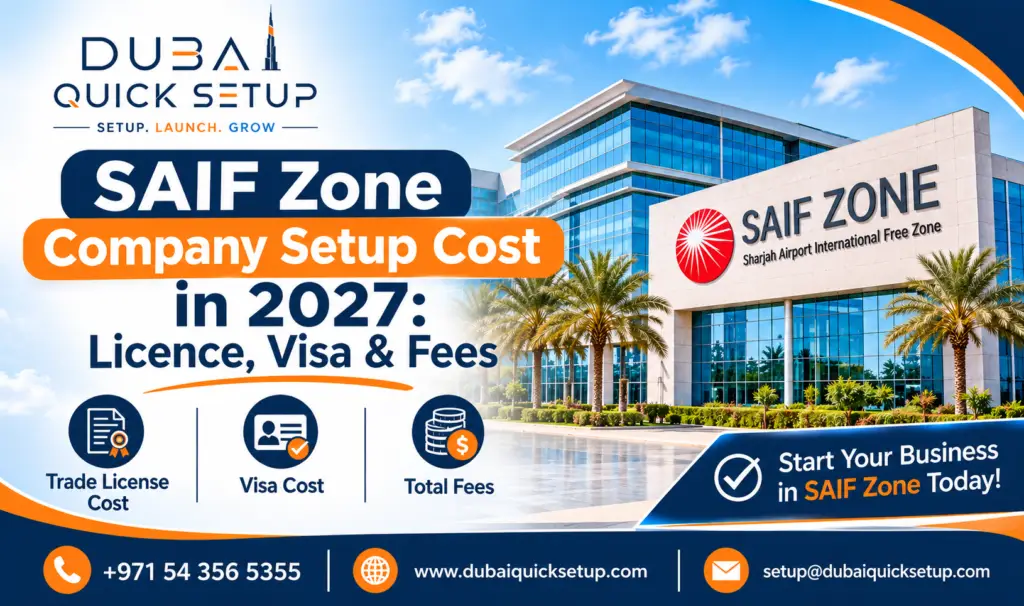
Choosing the right free zone is one of the most important decisions when starting a business in the United Arab Emirates. For entrepreneurs looking to establish a company in Sharjah, Sharjah Airport International Free Zone (SAIF Zone) is a strong option, especially for trading, import and export, logistics, distribution, consultancy, and industrial businesses.
Located next to Sharjah International Airport, SAIF Zone offers access to important air cargo infrastructure, business facilities, warehouses, and a range of licensing options. Its location makes it particularly relevant for businesses involved in international trade, product distribution, and manufacturing.
However, before establishing a company, investors usually have one important question:
How much does SAIF Zone company setup cost in 2027?
The total investment depends on several factors, including the selected business license, number of shareholders, office or warehouse requirements, visa allocation, immigration processing, and additional registrations.
Some business setup providers advertise attractive starting packages, but these prices may not include every expense associated with company formation. An entrepreneur who focuses only on the advertised licence price may underestimate the actual cost to establish and operate the business.
This guide by Dubai Quick Setup explains the SAIF Zone company setup cost in 2027, including license fees, investor and employee visas, office packages, registration charges, renewal expenses, documentation, and other important considerations.
Whether you are a foreign investor, an existing UAE business owner, a trader, or an entrepreneur planning to enter the UAE market, this guide will help you understand the costs and procedures before making your investment.
What Is SAIF Zone in Sharjah?
SAIF Zone stands for Sharjah Airport International Free Zone. It is a business and industrial free zone located adjacent to Sharjah International Airport in the Emirate of Sharjah.
The zone was established to support international trade, manufacturing, logistics, distribution, and other commercial activities.
SAIF Zone offers different business facilities and licensing arrangements, allowing investors to establish companies according to their operational requirements.
Its location is particularly useful for companies that depend on international shipping, air cargo, import and export operations, and access to regional markets.
Why do investors choose SAIF Zone?
Several features make SAIF Zone attractive to business owners:
- Strategic location next to Sharjah International Airport.
- Facilities for trading and distribution businesses.
- Access to warehouses and industrial facilities.
- Options for service-based businesses.
- 100% foreign ownership, subject to the applicable company structure.
- Repatriation of capital and profits, subject to applicable laws.
- Multiple license categories.
- Office and warehouse facility options.
- Business opportunities connected to international markets.
SAIF Zone is not necessarily the cheapest option for every type of business. Its suitability depends on the company’s activities, infrastructure requirements, and long-term plans.
For example, a company importing electronic products may value its airport location and warehouse facilities more than a consultant who primarily needs a basic office arrangement.
SAIF Zone Company Setup Cost in 2027: How Much Should You Budget?
The SAIF Zone company setup cost in 2027 depends on the package selected and the requirements of the investor.
Unlike some UAE free zones that publish detailed online package prices, SAIF Zone does not provide a complete current public tariff covering every license, facility, visa, and renewal charge.
Business setup providers advertise different indicative starting prices. Some market offers start at approximately AED 10,800, while other published estimates are around AED 13,100–13,390 or higher.
These are third-party advertised package prices, not a guaranteed official SAIF Zone tariff.
The actual quotation should be obtained in writing after confirming the activity, facility, shareholders, and visa requirements.
Indicative SAIF Zone setup budget
The following figures are useful for initial planning, not confirmed authority fees.
| Cost component | Indicative planning information |
|---|---|
| Basic license package | Some advertised packages start around AED 10,800–13,390 |
| License with additional activities | May cost more depending on the selected package |
| Investor residence visa | Additional processing expenses apply |
| Employee residence visa | Depends on applicable immigration and employment charges |
| Medical fitness test | Additional expense |
| Emirates ID | Applicable government charges |
| Establishment card | Additional registration expense |
| Office or flexi-desk | Depends on selected facility and package |
| Warehouse | Individually quoted according to size and requirements |
| Annual renewal | Confirm the current renewal quotation with SAIF Zone |
What is the estimated total investment?
For preliminary planning, some third-party providers advertise first-year company formation packages around AED 18,500–26,800 when selected visa and facility costs are included.
However, this is not a universal SAIF Zone price. The final amount may be higher depending on the number of visas, facility selection, additional activities, shareholder requirements, and other charges.
Investors should request an itemised quotation showing:
- License issuance.
- Company registration.
- Facility or lease charges.
- Establishment card.
- Immigration registration.
- Residence visa processing.
- Medical fitness test.
- Emirates ID.
- Health insurance, where applicable.
- Any additional government or service charges.
This approach makes it easier to compare different business setup packages accurately.
SAIF Zone Trade License Cost and Types in 2027
The type of trade license you select has a direct impact on your company formation requirements and operating permissions.
SAIF Zone offers three main license categories: Trade Licence, Service Licence, and Industrial Licence.
Each category is designed for a different type of business activity.
A. SAIF Zone Trade Licence
A trade licence is suitable for businesses involved in commercial trading activities.
According to SAIF Zone’s published business setup information, the trade licence covers activities such as:
- Importing products.
- Exporting products.
- Distribution.
- Consolidation.
- Storage.
- Warehousing.
The standard trade licence is subject to a maximum of three similar product lines under the published licence description.
This licence can be suitable for businesses dealing in:
- Electronics.
- Mobile accessories.
- Building materials.
- Furniture.
- General consumer products.
- Industrial equipment.
- Spare parts.
- Food products, subject to relevant approvals.
- Other permitted trading products.
Example: An entrepreneur planning to import electronic accessories from China and distribute them to international customers may consider a suitable SAIF Zone trade licence.
The permitted products and activity wording should be confirmed before submitting the application.
B. SAIF Zone Service License
A service license is designed for businesses providing professional and commercial services.
Examples of activities listed by SAIF Zone include:
- Business consultancy.
- Shipping and freight forwarding.
- E-commerce.
- Other permitted service activities.
It may be suitable for entrepreneurs establishing:
- Management consultancy businesses.
- Business support companies.
- Digital service providers.
- Marketing consultancies.
- IT service businesses.
- Professional service firms.
- Freight forwarding businesses, subject to applicable approvals.
Investors should verify the exact activity description because not every service can automatically be added to every licence.
C. SAIF Zone Industrial Licence
An industrial licence is intended for companies involved in manufacturing and industrial operations.
Activities may include:
- Manufacturing.
- Processing.
- Assembly.
- Packaging.
- Repackaging.
- Other permitted industrial activities.
SAIF Zone indicates that industrial activities are subject to clearance from its Health and Environment Department.
Industrial investors may also need to consider additional infrastructure, machinery, environmental, health, and safety requirements.
Important: The licence fee for an industrial company should not be compared directly with the cost of a basic service company. Industrial businesses may require significantly different facilities and regulatory arrangements.
SAIF Zone Office Packages and Facility Costs
The facility you select is another major factor affecting the total cost of establishing a company.
SAIF Zone offers different office arrangements, warehouse facilities, and industrial land options.
The right facility depends on the business activity, workforce, storage requirements, and operational needs.
A. SAIF Office
SAIF Office is a furnished and dedicated office arrangement designed for businesses that need an office presence without requiring a large commercial space.
According to the published SAIF Zone business setup page, this office arrangement includes a visa quota of three.
It may be suitable for:
- Small trading businesses.
- Consultancy companies.
- Startup businesses.
- Small service providers.
- Entrepreneurs with limited office requirements.
B. SAIF Executive Office
The SAIF Executive Office is an unfurnished and customisable office arrangement.
SAIF Zone describes it as including utilities and IT/telecommunications infrastructure.
Its published visa quota is five.
This option may suit businesses that require a more dedicated office environment and additional operational flexibility.
C. SAIF Suite
The SAIF Suite is a furnished executive office facility.
According to SAIF Zone, this facility includes an eight-visa quota.
It may be suitable for:
- Established trading companies.
- Larger consultancy firms.
- Commercial service providers.
- Businesses with multiple employees.
- Companies requiring a dedicated office environment.
D. SAIF Zone Warehouses
Companies involved in storage, distribution, manufacturing, and logistics may require warehouse facilities.
SAIF Zone provides pre-built warehouses in different sizes, including:
- 125 square metres.
- 250 square metres.
- 400 square metres.
- 600 square metres.
Warehouse selection should be based on the nature of the products, stock volume, loading requirements, machinery, and operational activities.
E. Industrial Land Plots
For investors planning larger manufacturing or industrial projects, SAIF Zone also offers land plots.
The published facility information describes plots starting from 2,500 square metres and above.
These options may be relevant for companies planning to develop customised factories or warehouses.
Land and facility expenses should be quoted separately because they cannot be estimated using a basic office package.
SAIF Zone Visa Cost in 2027: Investor and Employee Visas
Visa expenses are an important part of SAIF Zone company formation.
The total cost depends on the number of residence visas required and the applicable immigration procedures.
It is important to understand the difference between a facility’s visa quota and an actual issued residence visa.
For example, a SAIF Office package may include a quota of three visas. This does not necessarily mean that three residence visas have already been issued or that all immigration-related expenses are included.
Investor or partner visa
An investor or partner may apply for UAE residence through the established free zone company, subject to eligibility and the relevant procedures.
The process generally involves:
- Company incorporation.
- Relevant immigration and establishment registration.
- Entry permit or applicable status-change process.
- Medical fitness testing.
- Emirates ID application.
- Residence permit issuance.
- Health insurance, where required.
Employee residence visa
If you plan to recruit employees, you should calculate the associated visa and employment costs.
These may include:
- Employment-related approval.
- Entry permit.
- Medical examination.
- Emirates ID.
- Residence permit.
- Health insurance.
- Other applicable government charges.
The final amount depends on the employee’s circumstances and the applicable immigration and insurance requirements.
How many visas can you obtain in SAIF Zone?
SAIF Zone’s published office information lists the following quotas:
| Facility | Published visa quota |
|---|---|
| SAIF Office | 3 |
| SAIF Executive Office | 5 |
| SAIF Suite | 8 |
These are facility-related published quotas, not a guarantee of automatic visa issuance.
Additional visa capacity or employee arrangements should be discussed with SAIF Zone.
SAIF Zone Company Registration: FZE, FZC and Branch
Another important part of company formation is selecting the appropriate legal structure.
SAIF Zone provides different incorporation options.
A. Free Zone Establishment (FZE)
An FZE is a limited liability establishment owned by one natural or juridical person.
It has a separate legal identity and independent financial liability.
This option may be suitable for:
- Individual entrepreneurs.
- Single shareholders.
- Foreign investors.
- Existing companies establishing a separate business entity.
B. Free Zone Company (FZC)
An FZC is a limited liability company with more than one shareholder.
It also has a separate legal identity and independent financial liability.
This structure may be appropriate when two or more investors plan to establish a business together.
C. Branch of a UAE or Foreign Company
An existing UAE or overseas company may consider registering a branch in SAIF Zone.
A branch is connected to its parent company rather than being an independently incorporated subsidiary.
This structure may be useful for companies seeking to expand their UAE presence.
Minimum share capital requirement
One important point investors should understand is the minimum capital requirement published in the SAIF Zone FAQ.
SAIF Zone states a minimum capital requirement of AED 150,000 for an FZE or FZC. Its FAQ states that this requirement does not apply to branches of local or foreign companies.
This is a share capital requirement and should not automatically be treated as an additional government setup fee.
Investors should confirm the current capital requirements, evidence, and payment arrangements directly with the authority before incorporation.
Additional SAIF Zone Company Formation Fees
Apart from the basic licence and facility expenses, investors should consider additional registration and administrative costs.
These expenses vary depending on the company structure and visa requirements.
Establishment card
An establishment card is generally required for the company’s immigration-related processing.
It supports the company’s ability to handle relevant employee and residence visa procedures.
The applicable fee and renewal requirements should be confirmed in the final quotation.
Immigration registration
Depending on the application, immigration-related registration and administrative charges may apply.
These should be separated from the trade licence cost when comparing packages.
Medical fitness and Emirates ID
Residence visa applicants generally need to complete the relevant medical fitness procedures and Emirates ID application.
The cost can vary depending on the applicant’s circumstances and service category.
Health insurance
Health insurance is an important requirement to consider when planning residence visas and employee recruitment.
The applicable insurance requirements depend on the emirate and the individual’s circumstances.
Document attestation and translation
If shareholders are overseas or a corporate entity is involved, additional document processing may be necessary.
Possible expenses include:
- Document attestation.
- Notarisation.
- Certified translation.
- Legalisation.
- Power of attorney.
- Corporate resolutions.
These costs should be considered when preparing the total SAIF Zone company setup budget.
SAIF Zone Company Setup Cost for Different Business Types
The total investment varies according to the nature of the business.
Here are some examples of how different investors should approach their budget.
Trading company
A trading company may require:
- Trade licence.
- Approved product categories.
- Office facility.
- Visa allocation.
- Establishment registration.
- Customs-related arrangements, where applicable.
- Storage or warehouse facilities, if needed.
A business importing and exporting products should also assess customs documentation, logistics expenses, product compliance, and working capital.
E-commerce company
An e-commerce business may require a suitable service or trading activity depending on what it sells and how it operates.
Consider:
- E-commerce activity approval.
- Online store development.
- Payment gateway.
- Banking arrangements.
- Inventory and fulfilment.
- Import and export requirements.
- Customer service operations.
An online business selling physical products may need different activities from a business offering digital services.
Consultancy company
A consultancy business may need a service licence and an appropriate office arrangement.
Its initial expenses may be lower than those of a warehouse-based trading or manufacturing company because it may not require storage or industrial equipment.
However, the exact licence cost still depends on the selected activities and facility.
Logistics and freight forwarding company
Logistics businesses should assess their operating requirements before applying.
Depending on the service model, additional regulatory permissions or approvals may be required.
Consider:
- Freight forwarding activities.
- Shipping documentation.
- Warehouse facilities.
- Customs arrangements.
- Transportation partnerships.
- Operational staffing.
- Insurance.
Manufacturing company
Industrial investors should prepare a more comprehensive budget.
This should cover:
- Industrial licence.
- Factory or warehouse.
- Machinery.
- Equipment installation.
- Utilities.
- Environmental and safety approvals.
- Labour requirements.
- Raw materials.
- Operational working capital.
A basic free zone licence package is not a meaningful estimate of the total investment for a manufacturing project.
Documents Required for SAIF Zone Company Formation in Sharjah
Preparing the correct documentation can make the company registration process more efficient.
The documents depend on the proposed company structure and the shareholders involved.
For an individual shareholder
Commonly requested documents may include:
- Passport copy.
- Passport-size photograph.
- Contact information.
- Residential address.
- Proposed company name.
- Selected business activities.
- Business/project summary.
- Application forms.
- Additional KYC documents, where required.
For multiple shareholders
Additional information may include:
- Passport copies of all shareholders.
- Shareholding details.
- Proposed ownership structure.
- Company formation documents.
- Authorised signatory details.
- Additional declarations.
For corporate shareholders
An existing company establishing an FZE, FZC, or branch may need to provide:
- Certificate of incorporation.
- Commercial registration.
- Memorandum and Articles of Association.
- Board resolution.
- Power of attorney.
- Authorised signatory documents.
- Passport and identification documents of relevant individuals.
Overseas corporate documents may require attestation or legalisation depending on their origin and SAIF Zone’s requirements.
Dubai Quick Setup recommends confirming the latest documentation checklist before beginning the application.
Step-by-Step SAIF Zone Company Setup Process
The company formation process generally follows a series of stages.
Step 1: Understand your business requirements
Identify the business activities you want to conduct.
Decide whether the business will involve trading, consultancy, e-commerce, manufacturing, logistics, or another approved service.
Step 2: Select the licence category
Choose between the relevant trade, service, or industrial licence.
Ensure that the proposed activities match your actual business model.
Step 3: Select the legal structure
Determine whether you require an FZE, FZC, or branch registration.
Consider the number of shareholders and the ownership arrangement.
Step 4: Choose the facility
Select a suitable office, executive office, suite, warehouse, or other permitted facility.
Your facility choice may affect the available visa quota and total annual expenses.
Step 5: Reserve the company name
Submit your proposed trade name for approval.
The name must comply with the applicable free zone naming requirements.
Step 6: Submit the documents
Provide the required shareholder information, identification documents, application forms, and supporting paperwork.
Corporate shareholders may have additional requirements.
Step 7: Receive initial approval and complete registration
The authority reviews the application and supporting documents.
Once the relevant requirements are satisfied, the incorporation and licensing process can proceed.
Step 8: Pay the applicable charges
Review the itemised quotation and make the required payments through the authorised channels.
Step 9: Receive your licence and company documents
Once the application is approved and the necessary procedures are completed, the company receives its relevant registration and licence documents.
Step 10: Complete immigration and visa procedures
If you require UAE residence visas, proceed with the relevant establishment, immigration, medical, Emirates ID, and residence procedures.
Step 11: Apply for a corporate bank account
Approach suitable UAE banks with the company documents and required KYC information.
Bank account approval is subject to the bank’s independent due diligence and compliance checks.
How Long Does SAIF Zone Company Formation Take?
SAIF Zone promotes a streamlined business registration process and advertises licence delivery within one hour in suitable cases.
However, this should not be confused with a guaranteed completion time for every company formation.
The actual timeline depends on:
- Completeness of documents.
- Business activity.
- Shareholder structure.
- Additional approvals.
- Facility selection.
- Payment processing.
- Compliance checks.
- Overseas document attestation, where applicable.
Visa issuance and bank account opening are separate processes and may take additional time.
Entrepreneurs should obtain an estimated timeline for their specific application rather than relying on a general advertising claim.
SAIF Zone Annual Licence Renewal Cost in 2027
Company formation is not a one-time expense.
Investors must also budget for annual licence renewal and related facility expenses.
The SAIF Zone renewal cost depends on the company’s existing licence, facility arrangement, business activities, and other applicable charges.
Potential renewal components include:
- Trade licence renewal.
- Company registration or administrative charges.
- Office or facility lease renewal.
- Establishment card renewal, where applicable.
- Other relevant service charges.
If your company has a warehouse, industrial facility, or additional operational requirements, the annual renewal budget may be substantially different from that of a basic office-based company.
How to reduce renewal expenses
Entrepreneurs can manage renewal costs by:
- Selecting the right facility from the beginning.
- Avoiding unnecessary activities.
- Reviewing the required visa allocation.
- Maintaining accurate company records.
- Planning renewals before the expiry date.
- Obtaining a written renewal quotation.
Do not assume that the first-year promotional package price will remain the same at renewal.
Ask for both the first-year and subsequent-year cost breakdown before making your decision.
SAIF Zone vs Other Sharjah Free Zones: Which Is Better?
Sharjah has several free zones offering business formation opportunities.
The right choice depends on the type of business and the investor’s priorities.
SAIF Zone
SAIF Zone may be especially relevant for:
- International traders.
- Import and export companies.
- Distribution businesses.
- Logistics operations.
- Manufacturing companies.
- Businesses requiring warehouse facilities.
- Companies benefiting from airport proximity.
Sharjah Publishing City Free Zone
Entrepreneurs can explore Sharjah Publishing City Free Zone for business activities such as publishing, media, consultancy, and other approved commercial services.
Sharjah Media City (SHAMS)
SHAMS offers business setup opportunities for entrepreneurs working in media, creative industries, consultancy, and other permitted business activities.
Hamriyah Free Zone
Hamriyah Free Zone is worth considering for industrial, manufacturing, maritime, logistics, and warehouse-oriented businesses.
Can a SAIF Zone Company Do Business in Dubai and Other Emirates?
This is an important consideration for investors planning to serve customers throughout the UAE.
A free zone licence should not automatically be treated as unrestricted permission to carry out every commercial activity anywhere in the UAE mainland.
SAIF Zone’s FAQ explains that the licence is valid for operating within the free zone territory and that operations elsewhere depend on applicable rules and approvals.
For mainland business activities, investors should verify the appropriate legal route with the relevant authorities.
Depending on the activity and business model, this may involve an appropriate mainland licence, branch arrangement, permit, or other approved structure.
For example, a company registered in SAIF Zone may have different requirements for:
- Selling goods to mainland UAE customers.
- Providing services directly to mainland customers.
- Establishing a mainland branch.
- Operating a physical retail outlet.
- Conducting regulated commercial activities.
The rules can also differ depending on whether the transaction involves importing goods, distributing products, or providing services.
Dubai Quick Setup recommends checking the intended customer locations and delivery arrangements before finalising the company structure.
Corporate Tax and VAT for SAIF Zone Companies
Tax planning is another important part of establishing a UAE free zone company.
Investors should understand that free zone registration does not automatically mean that all company income is exempt from corporate tax or VAT.
UAE Corporate Tax
The UAE corporate tax framework generally provides:
- 0% corporate tax on taxable income up to AED 375,000.
- 9% corporate tax on taxable income exceeding AED 375,000 under the standard regime.
A Qualifying Free Zone Person may benefit from a 0% rate on qualifying income if all applicable conditions are satisfied.
However, non-qualifying income is subject to the applicable corporate tax treatment.
To maintain qualifying status, a free zone company must satisfy the relevant requirements, which may include:
- Maintaining adequate substance in the UAE.
- Deriving qualifying income.
- Complying with transfer pricing requirements.
- Maintaining audited financial statements.
- Meeting other prescribed conditions.
Simply obtaining a SAIF Zone licence does not automatically qualify a company for the 0% corporate tax rate.
VAT registration
The UAE standard VAT rate is 5%.
Mandatory VAT registration generally applies when taxable supplies and imports exceed AED 375,000 over the relevant preceding 12-month period or are expected to exceed that amount within the next 30 days.
Voluntary VAT registration may be available when the relevant threshold of AED 187,500 is met.
Designated Zone considerations
Investors should also distinguish corporate tax treatment from VAT treatment.
Certain free zones may have designated zone status for specific VAT purposes. However, the VAT rules are not a blanket exemption for all services and transactions.
The treatment of goods, services, imports, and supplies must be assessed according to the applicable VAT legislation.
For this reason, businesses should obtain professional tax advice based on their actual transaction model.
Corporate Bank Account Opening After SAIF Zone Setup
Opening a corporate bank account is an important step after company incorporation.
A valid trade licence does not automatically guarantee bank account approval.
UAE banks conduct their own due diligence and may request information about the business model, shareholders, expected turnover, source of funds, and customer locations.
Commonly required documents
Banks may request:
- Trade licence.
- Certificate of incorporation.
- Memorandum of Association.
- Shareholder passport copies.
- Emirates ID, where applicable.
- Residence visa documents, where applicable.
- Proof of business address.
- Business plan.
- Expected transaction information.
- Source of funds documentation.
- Supplier and customer information.
How to improve your chances of approval
Prepare a clear business explanation.
For example, if you are opening a general trading company, explain:
- What products you will trade.
- Where products will be sourced.
- Which countries you will sell to.
- Who your expected customers are.
- How payments will be received.
- What your expected annual turnover will be.
For a consultancy company, explain the services, target clients, and expected revenue model.
The bank will assess the application independently, and approval cannot be guaranteed by a business setup consultant.
Is SAIF Zone a Good Choice for Your Business in 2027?
SAIF Zone can be a suitable option for entrepreneurs who want to establish a company in Sharjah with access to airport-related infrastructure and a range of business facilities.
It may be particularly relevant for international trading, distribution, manufacturing, shipping, and logistics operations.
However, it may not be the most economical choice for every startup.
If your business requires only a basic service licence and minimal facilities, other Sharjah free zones may also be worth comparing.
Before deciding, assess:
- Your business activity.
- Number of shareholders.
- Number of required visas.
- Office or warehouse requirements.
- First-year setup expenses.
- Annual renewal expenses.
- Share capital requirements.
- Customer locations.
- Banking and compliance requirements.
A well-planned company formation decision can help avoid unnecessary amendments and expenses later.
How Dubai Quick Setup Can Help With SAIF Zone Company Formation
Selecting a free zone, understanding licence categories, preparing shareholder documents, and calculating the actual setup investment can be challenging, especially for entrepreneurs establishing their first UAE company.
Dubai Quick Setup supports entrepreneurs, international investors, and existing business owners who want to establish or expand their presence in the UAE.
We help investors understand their company formation requirements before proceeding with registration.
Our SAIF Zone company setup assistance can include:
- Business activity assessment.
- SAIF Zone licence selection.
- FZE and FZC structure guidance.
- Branch registration guidance.
- Trade name application assistance.
- Shareholder documentation.
- Company registration coordination.
- Office and facility requirement guidance.
- Investor and employee visa process guidance.
- Establishment and immigration registration assistance.
- Corporate bank account application guidance.
- VAT and corporate tax registration support through appropriate professional services.
- Annual renewal guidance.
- Mainland and free zone comparison.
Why speak to Dubai Quick Setup before registering?
Every investor has different business requirements.
An entrepreneur establishing an e-commerce business may need a different licence and facility from an investor planning to import products and operate a warehouse.
Rather than recommending a package based only on its starting price, we encourage investors to consider their actual operational requirements.
Our objective is to help you understand the relevant options, identify the applicable costs, and choose a company formation structure that supports your business plans.
In conclusion, The SAIF Zone company setup cost in 2027 depends on more than the price of a business licence.
Your total investment will be influenced by the selected licence category, business activities, office or warehouse requirements, visa allocation, registration expenses and annual renewal obligations.
SAIF Zone offers several advantages for trading, logistics, industrial and service businesses, particularly for entrepreneurs who value access to Sharjah International Airport and purpose-built business facilities.
However, the right setup depends on your individual requirements.
Before proceeding, request a detailed written quotation, verify the current authority fees and understand the annual renewal expenses.
Get a SAIF Zone company setup quotation based on your requirements.
Contact Dubai Quick Setup:
Website: https://dubaiquicksetup.com/
Email: setup@dubaiquicksetup.com
Phone / WhatsApp: +971 54 356 5355
Frequently Asked Questions About SAIF Zone Company Setup Cost
There is no single confirmed cost applicable to every SAIF Zone company. The total depends on the licence type, business activities, office or warehouse, visa requirements and applicable registration charges. Request a current written quotation for an accurate budget.
SAIF Zone does not publish a comprehensive current licence price list on its main business setup page. Older administrative fee schedules contain licence fee bands, but these should not be treated as confirmed current incorporation prices.
Some packages include a facility with a specified visa quota. However, an available quota does not necessarily mean the actual residence visa processing expenses are included. Check the quotation for visa, medical, Emirates ID, and other charges.
The published facility information lists three visas for SAIF Office, five for SAIF Executive Office, and eight for SAIF Suite. Actual visa issuance remains subject to the applicable requirements.
SAIF Zone’s published FAQ states a minimum capital requirement of AED 150,000 for an FZE or FZC. It also states that branches of local or foreign companies do not have this minimum capital requirement.
Yes. SAIF Zone offers trade licences for approved trading activities, including import, export, distribution and storage. The exact products and activities must be approved.
An FZE is a limited liability establishment with one shareholder. An FZC is a limited liability company with more than one shareholder.
SAIF Zone advertises a streamlined licensing process and licence delivery within one hour in suitable cases. Actual incorporation timelines depend on the documents, approvals, and application requirements. Visa and banking procedures are separate.
A qualifying free zone person may benefit from a 0% corporate tax rate on qualifying income if it meets the applicable conditions. Other income may be taxed under the standard UAE corporate tax rules.
It depends on your business activity. SAIF Zone may be particularly relevant for trading, import/export, warehousing and industrial businesses. SPC Free Zone and SHAMS may be worth comparing for certain service, creative and startup businesses.
Yes. Dubai Quick Setup can assist with understanding company formation requirements, business activities, licence options, visa requirements, documentation and available UAE business setup solutions.

Mohamed Aasik is an SEO Expert in Dubai and the CEO of Shaaz SEO Agency. With over 10 years of experience in search engine optimization, digital marketing, and website strategy, he helps businesses across the UAE and GCC improve their online visibility, generate qualified leads, and achieve sustainable growth.